
James Cameron | 187 mins | TV (HD) | 12 / PG-13
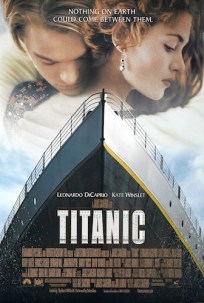 Before Avatar came along and ruined everything — um, I mean, dominated both the box office and James Cameron’s career — the director seemed to have become best-known for his previous record-breaking box-office-topper, Titanic. And because he was so well known for it, it’s easy to forget that it stands out like a sore thumb in his filmography: previously he’d only been responsible for action and/or sci-fi films: The Terminator, T2, Aliens, The Abyss and True Lies. And, lest we forget, Piranha 2. And, in the years since his ship-based behemoth, his only fiction film is Avatar, which you may remember — it was a little film about some blue aliens on a moon.
So, despite Titanic’s slightly-ironic runaway success (considering the fate of the titular vessel), one still has every reason to question if Cameron can handle a straight-up drama. After all, dialogue and character are hardly his strong points, and box office success and Oscar victory are hardly reasons to suppose a film is any good.
The first thing one can note about Titanic is that it’s over-reaching itself size-wise. This is true of both vessel and film, one being too big to dodge an iceberg, the other simply too long. I can’t be certain, but it feels like the entire film following the iceberg’s arrival is in real-time, which would make the length an excusable narrative trick — I do like real-time — were it not for Cameron padding it out with endless contrivances to have Jack and Rose running around the ship. All of these sequences are suitably exciting in themselves, but there’s so many of them that they become dully repetitive.
But before the good bit — giant boat sinking! Yay! — there’s the Jack-Rose romance, clearly the main draw for many fans. I can’t help feeling they need to be shown some better films. It’s not quite as weak as George Lucas’ efforts in Attack of the Clones, but it’s not far off.  The scene the day after Jack saves Rose — where they have a natter on deck and she looks at his art for the first time; aka the primary scene for their falling for each other — is particularly weakly written. “Oh Jack, the plot requires me to look at your drawings now, so please hand them over.” The dialogue’s not actually that bad, but it’s bloody close.
The film really takes off with the iceberg. While my criticism still stands that it goes on too long from this point (just as it does before it, mind), the post-impact scenes are by far the most exciting and engaging sequences in the film. The predictable romantic plot may keep Leo’s fans flocking back, but the horrendous spectacle of the sinking ship — both visually in an array of epic wide shots, and emotionally in the various and changing ways the passengers and crew react — is the film’s real triumph, a reason for the rest of us to even consider revisiting it.
Even if spectacle is the real star, there are some actors too. Kate Winslet does fine work with a character who could just be (and occasionally is) a cliché. As the same character 85 years later, Gloria Stuart gives an even better, emotionally resonant performance. Billy Zane and David Warner are perfectly dastardly villains, Bernard Hill practices the stoic leader he would later perfect in The Lord of the Rings, and Kathy Bates provides some intermittent comic relief.
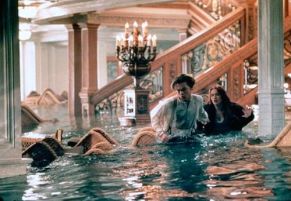 And Leo is pretty-boy Leo. I’m not saying he’s not a talented actor — that was something he’d shown before Titanic and has certainly proven since, though everyone seemed to forget it in the late ’90s — but Jack Dawson is hardly a tricky task for him. Clearly he looks beautiful, has the loveable rogue thing down, and that’s job done.
Russell Carpenter’s cinematography is always up to the task with a nice degree of diversity, from Michael Bay-style tech-fetish crispness in the present-day bookends to a warm glow for the past of Rose’s memory, with an icy collision of the two as disaster strikes. On a similar note, the CGI has aged surprisingly well… provided you don’t look too closely, at least. And I do mean “surprisingly” in the most literal sense, because I expected it to look awful. I swear it did last time I saw a clip. Anyway…
None of this can be said for James Horner’s irritating score. While not as bad as the batter-you-round-the-head signposting of his work on Avatar, it has a similar sense of obviousness. His frequent use of motifs from Celine Dion’s irritating My Heart Will Go On is always unwelcome, and (for me) always drags French and Saunders into the equation — “my heart will go ooooooooon” and all that.
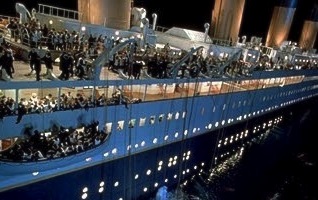 Indeed, Titanic’s literally phenomenal success, and the subsequent abundance of spoofs and homages across all media in the decade-and-a-bit since, is an obstacle for any new viewer. One can’t watch Jack declare “I’m the king of the world!” without thinking of Cameron’s much-derided Oscar speech; can’t watch Jack and Rose ‘flying’ without thinking of any number of piss-takes; and French and Saunders spring to mind quite all over the place.
And yet, despite all this criticism, I found myself quite liking Titanic. I didn’t expect to, which is why I’ve avoided it for so long. I could take or leave the romance — could take it better if they’d gotten someone in to polish the script — and while they were at it they could’ve trimmed the second half’s repetition — but, all things considered, there’s enough spectacle to keep one engrossed.
Over-long and based on spectacle over content? Reminds me of this little film about some blue aliens on a moon…

Titanic is on Channel 4 tonight, Sunday 13th July 2014, at 7pm.
 Apparently, the recent Michael Caine-starring
 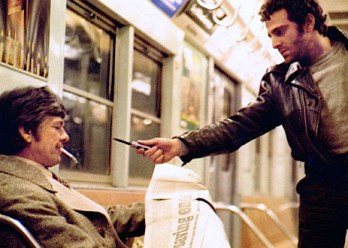 The strongest element is probably Wendell Mayes’ script, because it constructs all this. Weakest is Michael Winner’s direction — some of it’s fine, the occasional shot even good, but largely it’s pedestrian and sometimes mediocre. That said, Winner has become such an unlikeable public figure that it’s somewhat difficult to gauge how much of this is bad direction and how much bias. Still, it’s not the kind of work to make one think, “he’s an idiot, but he knows how to do his job”.
 I don’t really care about fashion, which means I really don’t care about Fashion — i.e. the world inhabited by Vogue and its American edition’s infamous editor, Anna Wintour. But I did watch
  Wintour, one suspects, will always be unknowable, a figurehead more than a person; but Grace is relatable, as human as the rest of us.
 Speed Racer feels like an unfair place to kick off
  Even some of the performances stand out, not something you’d expect from such a (for want of a better word) lightweight tale. Of particular note are Susan Sarandon as Mom and Christina Ricci’s Trixie, whose huge eyes help render her perhaps one of the most perfect live-action versions of an anime character ever seen. Yes, the characters mostly exist to service their place in the plot, but the odd scene or glance or line delivery adds some subtlety here and there.
 And, to specifically rubbish his opinions here, Phantom Menace is praised for being “made to be looked at more than listened to… filled with wonderful visuals” and condemns Speed Racer because “whatever information that passes from your retinas to your brain is conveyed through optical design and not so much through more traditional devices such as dialogue, narrative, performance or characterization… you could look at it with the sound off and it wouldn’t matter.” Not that Film’s unique factor (over novels or radio or what have you) is its visual sense, and a silent film that can be told through image alone, devoid of any intertitles, was once a lofty aim. I’m sure Ebert could readily explain why Phantom Menace’s visual splendour is a good thing and why Speed Racer’s is so terrible, but, on the other hand… pot, meet kettle.
 Back to Speed Racer. In every respect it’s like a living cartoon, and it’s the Wachowskis’ commitment to this aesthetic in every single respect that makes it work where others have floundered. It’s not perfect, I suppose. It may run a little long at two-and-a-quarter hours; but then, it so rarely lets up that I didn’t mind a jot. And the kid is often annoying; but then, as annoying little kids in films go, I’ve seen worse. At times I even liked him.
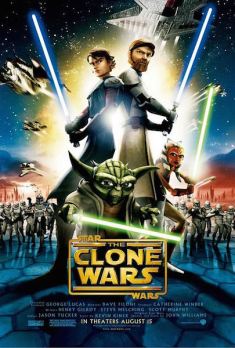 The Clone Wars can boast an awful lot of firsts within the
  Catherine Taber’s Padmé impression is probably the most convincing of the lot and, coincidentally sharing the same scenes, Corey Burton’s Truman Capote impression as Ziro the Hutt is entertainingly obvious. Count Dooku doesn’t particularly benefit from the involvement of Christopher Lee, but at least Samuel L. Jackson is vaguely recognisable lending his actual voice to Mace Windu. Most of the cast deliver the kind of performance you typically find in kids’ cartoons — i.e. not all that good, no doubt due to the pressures of producing as many episodes as possible as cheaply as possible. Dubious line readings abound, though in fairness this may be down to the awkward lines they’re forced to deliver.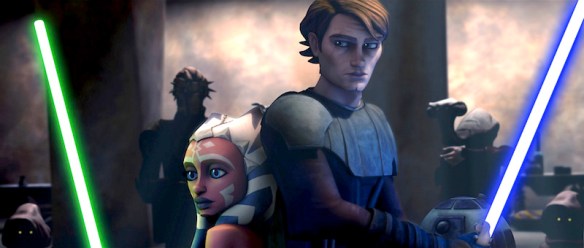
 It may sound like a piece of trivia that this was originally conceived as three episodes of
  it just doesn’t have the epic quality that imbued all the other Star Wars films. Not every film has to be an epic, even ones set within the same universe/storyline, but by wheeling out all the main characters and then showing them complete just one moderately low-key mission, The Clone Wars does feel like a single instalment of a TV series and not an appropriately-scaled cinematic experience.
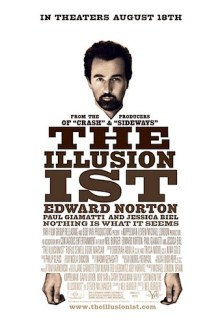 A Blu-ray release of The Illusionist has just
 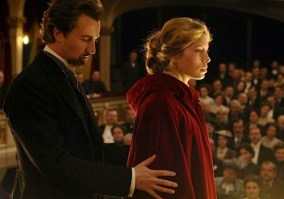 The story itself — you remember those? It’s the bit between the attention-grabbing opening and preposterous-twist finale — is mediocre with or without the finale. It’s a something-and-nothing account of a Poor Boy who loves a Rich Girl he can’t have and… oh, I can’t even be bothered to explain it.
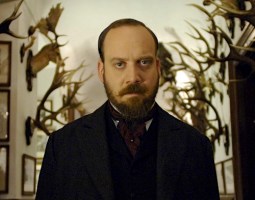 As comparisons with The Prestige are inevitable, particularly as both films were ultimately released around the same time, I’ll briefly put them head-to-head. Both concern stage magic in a similar-enough period setting, debate about whether the tricks are just that or actually supernatural powers, a love story that goes awry, which involves a fatal rivalry… But they’re actually very different films. The Prestige jumps about in time in a more complex way than The Illusionist, but this also has a point. The former’s story is more original, more engaging, its use of magic — real or not — more captivating. I fear I could go on, but it’s succinctly summed up thus: in this comparison, The Illusionist comes up short.
 100Films.co.uk