May 2010

Being the films I watched in the month of May, in the year of 2010, that count toward my goal of seeing 100 films this year.

I imagine you worked most of that out for yourself.


What this isn’t

I’ve decided to start putting these little lists up every month as a way of keeping the blog current and offering myself a chance to reflect on How Things Are Going. Having switched to longer reviews in the blog’s second year, and ultimately abandoned posting them in order too, I feel I’ve lost this side of things a little. And without it, the whole exercise becomes just a random selection of films.

Not that there’s anything wrong with that (he says quickly, not wishing to offend any blogs of this nature), but most of the regularly updated blogs here on FilmJournal have a focus — be it Eastern, Western, retro, current, or what have you — and it’s made me miss my USP a little. Well, now I just sound like I’m trying to sell myself. This isn’t The Apprentice.

I’m not wholesale returning to 2007-style though — this is a little summary in advance (or, sometimes, after) my full-length review, not replacing it with paragraph-sized soundbite summaries again. Hopefully this is A Good Thing and no one would rather I was scaling back (though, I suppose, if you’re spending time reading a blog you don’t actually like, why are you here? I have plenty of blogs I like that I don’t read regularly enough, never mind ones I don’t. But I digress.)


May. Finally.

Ah, May. Spring. Or Summer. Or neither, in the UK. I don’t know. I still stay inside watching TV and movies, so what does it matter?

After a lacklustre April (just three films) things have picked up considerably — indeed, this May sees me definitively pass the halfway point. This leaves me about a week and a half ahead of where I’d reached in The Mythical First Year, which ended on 129 films, so that bodes well for the future. Though, in all honesty, I can’t help feeling a little disappointed: in March I’d stormed to around 13 films ahead of my place in 2007, while now I’m lurking only one or two ahead — a poor week and I’d be behind again. But after the last two years — where, as you may remember, I only just made it and then failed — being 16 ahead of target is undoubtedly A Good Thing.

Anyway, here are the 16 (numerical-coincidence-tastic) films I actually watched this month:


#42 Burn After Reading (2008)
#43 Inkheart (2008)
#44 First Blood (1982)
#45 Sherlock Holmes (2010)
#46 Righteous Kill (2008)
#47 The Chronicles of Narnia: Prince Caspian (2008)
#48 Taken (2008)
#49 Sherlock Holmes (2009)
#50 Sword of Sherwood Forest (1960)
#51 Tu£sday (2008)
#52 Insomnia (1997)
#53 Coraline (2009)
#54 Knowing (2009)
#55 Ivanhoe (1952)
#56 National Treasure: Book of Secrets (2007)
#57 Max Payne (2008)


Quick word on comments

While I’m editorialising, I thought I’d have a quick word on comments. And that word is, “sorry”. With the addition of “, maybe”.

I don’t normally go through the spam-filtered comments because there’s a lot of them and they’re unwaveringly spam. Except they’re not, because one of the comments on National Treasure 2 had wound up in there. I happened to spy it by some stroke of fortune and saved it. And I like comments so it would’ve been a shame to lose it.

So, sorry if you’ve ever commented on this blog and it hasn’t shown up. I didn’t delete it, Cub’s Honour, it just got lost in the spam somehow.

There, that’s cleared my conscience.


Next time on the all-new 100 Films in a Year monthly update…

It’s June! Halfway through the year ‘n’ all that. Just how far will I have got? Will I beat May’s record-breaking 16 films? Who knows? Not me!

See you in 31 days.

Apart from all the reviews I post in that time.

And on Twitter.

And…
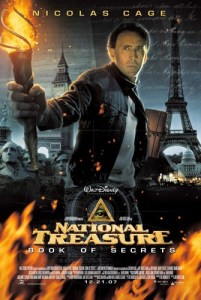
National Treasure: Book of Secrets (2007)

2010 #56
2007 | Jon Turteltaub | 119 mins | DVD | PG / PG

I enjoyed the first National Treasure. There, I said it. I’ve wound up seeing it several times, somehow, and each time appreciated it as a fun romp. It’s not a fashionable film to like by any means, and it’s certainly derivative of all kinds of other things, not least The Da Vinci Code, but it’s an entertaining and consummate minor blockbuster.

National Treasure 2 (that’s this one, in case you didn’t know) essentially offers more of the same. That’s often levelled as a criticism, but in this instance it’s absolutely fine: Book of Secrets isn’t a rehash — there’s a new mystery with new puzzles — but is another adventure in the same vein, with clue-hunting and the occasional action sequence. Things are different, but it’s rather swings and roundabouts. For example, Ed Harris isn’t as fun a villain as Sean Bean, but he’s also suitably different, while on the other hand the London car chase bests any action sequence in the first film.

There’s also the usual sequel escalation: never mind just getting the Declaration of Independence, here Gates & co not only break into the Queen’s office in Buckingham Palace, they also kidnap the President of the United States (briefly. Sort of.) Yes, it’s wildly improbable, not only in the clue-laden treasure hunt but also the feats this three-person team pull off. But that’s half the fun. It doesn’t claim to be real — OK, it uses historical facts, but they’re to embellish its tale, in the same way many higher-class films have — it’s just an entertaining ride, with some exciting action, intriguing clues, and the odd bit of humour.
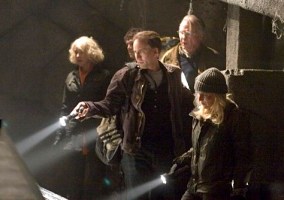
The cast are fine. The unforgiving will find Justin Bartha’s Riley irritating, but by making him a tad down on his luck and a little devoted to Gates he may endear himself to others. Aside from Ed Harris, Helen Mirren is the biggest addition, though both make little more than a cameo when there are so many other characters and plot points flying around. The main attraction of her role is pondering her accent — is it meant to be American? I wasn’t sure. Perhaps she was doing a very good job of being A Brit Who’s Lived In America For A Long Time, but that’s a mite too subtle for all the noise and bluster in a fast-paced conspiracy adventure-thriller.

There are plot holes and logic gaps and it rather leads you by the hand through it all, but none of these undermine what it’s really all about. Either that or I was in a particularly forgiving mood — even the thoroughly daft bit with the traffic camera didn’t bother me too much. It’s not the highest class of blockbuster, it won’t be remembered as fondly as Indiana Jones, or even the Pirates series, but there are worse ways to spend a couple of hours, particularly if all you want is a bit of well-made light entertainment.

If you enjoyed the original, I see little reason why you wouldn’t enjoy the sequel; conversely, if you didn’t like the first one… I’m sure you can finish that sentence. It’s the kind of film that would probably sit quite well on, say, a Bank Holiday afternoon. Which is a stroke of luck.

4 out of 5

The UK TV premiere of National Treasure: Book of Secrets is on BBC One tomorrow, Bank Holiday Monday, at 4:35pm.

Coraline (2009)

2010 #53
Henry Selick | 100 mins | Blu-ray | PG / PG

I’ve only ever read one thing by Neil Gaiman. It’s not fan-favourite Neverwhere, nor the previously-adapted Stardust. It’s not Hugo-winners American Gods or The Graveyard Book, nor the Hugo-withdrawn Anansi Boys. It’s not any of Sandman. It’s not even Whatever Happened to the Caped Crusader?, his take on Batman.
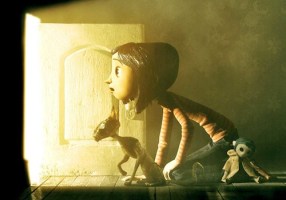
And it’s not Coraline either.

Which is a shame, because either that or “I’ve never read anything by Neil Gaiman” would have made much better introductions. Indeed, the latter was my original plan, but honesty overcame me — I’ve read his graphic novel/miniseries Marvel 1602. And I just remembered that I’ve also read Good Omens, the novel he co-wrote with Terry Pratchett. So much for my neat little introduction.

But regardless of one’s familiarity with Gaiman, his work comes recommended. Coraline alone won a Hugo, Nebula and Stoker, while the film adaptation was Oscar-nominated (naturally it lost to whichever Pixar film was eligible) and widely well reviewed (an 89% Tomatometer). All of which seems to set it up for a fall. But like, say, The Dark Knight*, it manages to fulfil its promise — Coraline, in short, is excellent.

Where to begin? Well, Coraline is a fairytale, really, albeit a modern one — it doesn’t come at you with princesses or witches or talking animals, but Volkswagens and new homes and stairlifts (all or none of those may be significant to the plot). The fact it’s a fairytale is perhaps neither here nor there, though I do think it pushes aside some logic complaints I’ve seen levelled against the film — do we need a villain’s origins, for example? No, not here. I’m not saying Coraline uses its fairytale basis as an excuse to toss aside narrative sense, just that, if viewed through the prism of “fairytale story rules” rather than “real-world fantasy story rules” some viewers may have been more forgiving. Also, I’m digressing into a critical blind alley.
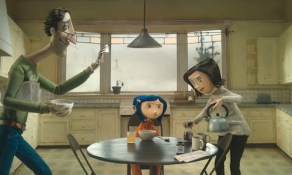
It’s also a Proper fairytale, by which I mean two things: one, it has a moral message; two, it’s scary. Very scary, in places. For much of the film there’s a beautiful creepy atmosphere, enhanced by drifting fog and skewed camera angles, but towards the end — when (I write while trying not to spoil too much) the full truth of the Other Mother is revealed — it’s not just kids who are likely to be freaked out. Dark themes and situations abound, though the full implications of some are pared back or glossed past, probably with good reason. Coraline is a “kid’s film” but, like writer/director Henry Selick’s previous The Nightmare Before Christmas or much of Pixar’s output, it’s as least as enjoyable for adults.

And as for the moral subtext… well, it may be very familiar — “be careful what you wish for” and/or “you don’t know what you’ve got till it’s gone” — but Gaiman and Selick certainly have a new, fantastical, mythical spin on it. Some critics say the story is arranged from plot points seen elsewhere and lacks originality, but then critics of everything say that because every story has roots in another. Coraline’s telling displays more than enough originality to keep it going, thankyouverymuch.

The animation, however, is an undeniable triumph. Set and character designs are gorgeous; the stop-motion movement is fluid, nuanced and detailed; the numerous technical accomplishments impressive. Sequence after sequence dazzles, each more magical — or frightening — than the last. Even if you want to criticise the story or characters, I find it hard to believe anyone could watch this and not enjoy much or all of it on a visual level. And if you don’t — honestly, are you sure you like films?

Only occasionally is one reminded that Coraline was filmed in 3D, when things poke out towards the screen or sink deep into it; but it’s not gratuitous, and if you didn’t know it was designed for 3D you might not even notice. The flattened sets and awkward perspective of the real world, versus the depth and beauty of the Other one, are still conveyed well in 2D. (I’ve had a brief look at the 3D version contained on the Blu-ray disc and will report my views on that another time, when I’ve attempted to watch it in full.)

Much like the animation, Bruno Coulais’ score is hauntingly beautiful. OK, it’s undoubtedly Elfman-esque, but it fits the film to a tee. Also in the audio realm (yes, this is a tenuous link to join two brief comments in a single paragraph), the voice cast are all spot-on, from seasoned pros like French and Saunders to bright young thing Dakota Fanning. Some may take issue with her vocal, or the character, but… well, allow me to employ a longer paragraph:

Reading some other reviews and their comments, it becomes apparent that one’s opinion of the film may depend a little on one’s opinion of Coraline herself. Roger Ebert, for example, considers her to be “not a nice little girl… unpleasant, complains, has an attitude and makes friends reluctantly”, though he notes that “it’s fine with me that Coraline is an unpleasant little girl. It would be cruelty to send Pippi Longstocking down that tunnel, but Coraline deserves it. Maybe she’ll learn a lesson.” For me, however, Coraline is an independent and strong-willed individual with good reason for most of her grievances. Does she need to learn a lesson? Undoubtedly. This is a fairytale, after all, and lesson-learning is more-or-less the point. Perhaps if you think Coraline is unlikeable and deserves the woes heaped upon her you’ll like the film less (I should add that Ebert gave it three-out-of-four, however); but if you get on with the character — and I’m certain many among the film’s supposed target audience, kids, would — then she’s a likeable companion to learn the story’s lesson with.
In general, I’m unconvinced by the criticisms I’ve read. Even those who assert it’s too scary for children tend to have shown it to kids who were too young — please, think about what Parental Guidance actually means before you go showing a PG to a three-year-old. All I can end with is a reiteration of my earlier comment: Coraline, in short, is excellent.

5 out of 5

* I’m well aware I could choose any number of classic films whose reputation precedes them. The Dark Knight, however, is similar to Coraline in that it’s a recent release where we’re looking at a year or two of praise & rewards rather than decades of considered thought. Ergo, it’s a better point of reference.

Coraline begins on Sky Movies Premiere today at 10am and 5:30pm, and is on every day at various times until Thursday 10th June.

It placed 6th on my list of The Ten Best Films I Saw For the First Time in 2010, which can be read in full here.

Pixels (2010)

2010 #40a
Patrick Jean | 3 mins | download

Pixels falls somewhere between a commercial and a CGI showreel, albeit one with a definite narrative and a dizzying amount of fun.

The plot is simple: characters and graphics from old 8-bit computer games escape and run riot over New York City. We’re talking Space Invaders firing on real streets, Tetris blocks crashing onto buildings, Donkey Kong hurling barrels from the top of the Empire State Building, Frogger hopping across a road of real traffic… For people of A Certain Age (a little older than me, it must be said) it’s an explosion of nostalgia, but everyone can be impressed by the CGI on display. My personal favourite is the effect of Tetris blocks on that building, but I won’t spoil it here.

Rather than just being a high-concept showcase, director Patrick Jean relates a story. It’s slight and dialogue-free, true, but then this is only two-and-a-half minutes long and, really, is a showcase more than a fully-fledged film. Considering the film’s point — a series of videogame-inspired vignettes — a narrative is virtually unnecessary, but tying them together with one anyway is a pleasing touch.

The visuals and execution of the humorous premise easily hold the attention for the brief running time, however, and I’m sure the former are set to do the film’s real job proficiently — i.e. win One More Production lots of work.

4 out of 5

Pixels can be watched in full on the production company’s website.

A feature-length adaptation is released in the US tomorrow, 24th July 2015, and in the UK on Wednesday 12th August.

Another pair of shorts for summer

The sunny weekend weather is beginning to fade already, heading for a typically dreary Bank Holiday — not that I’m complaining, personally, but I suppose I’m an aberration. Will that be all the summer we get, I wonder? I doubt I’m so lucky. But just in case it does get sunny again, here’s a pair of shorts! Not that you can wear them.

And yes, I did this joke before. Almost a year ago. But it’s such an outstanding slice of humour I figured it would bear repetition. Probably every year.

As per before, neither of these really have a connection, either to summer or to each other, beyond that I’ve had each review sat to post for a while. Click the title for the full review.

Before Sky Captain, there was this: a six-minute reel, shot, edited and, er, special-effects-ed, by Conran on an amateur basis over four years, demonstrating the production techniques and storyline he had in mind for a feature-length homage/reimagining of ’40s cinema serials.

2010 #40a
Pixels

characters and graphics from old 8-bit computer games escape and run riot over New York City. We’re talking Space Invaders firing on real streets, Tetris blocks crashing onto buildings… For people of A Certain Age it’s an explosion of nostalgia, but everyone can be impressed by the CGI on display.


The World of Tomorrow is available on the DVD and Blu-ray of Sky Captain and the World of Tomorrow. Pixels is available free online.

Taken (2008)

2010 #48
Pierre Morel | 93 mins | Blu-ray | 18

“I don’t know who you are. I don’t know what you want. If you are looking for ransom, I can tell you I don’t have money. But what I do have are a very particular set of skills; skills I have acquired over a very long career. Skills that make me a nightmare for people like you. If you let my daughter go now, that’ll be the end of it. I will not look for you, I will not pursue you. But if you don’t, I will look for you, I will find you, and I will kill you.”

So goes Liam Neeson’s famous (ish) mission statement in the latest (ish) action-thriller from the team behind The Transporter series. You need know little more of the plot, though it still takes half an hour to get to that little speech.

If you do want to know more of the plot… well, remember Man On Fire? The Tony Scott/Denzel Washington one (I presume the older one’s the same, but I’ve not seen it). Well, replace Washington with Neeson and Dakota Fanning’s character with “his daughter” and you’ve more or less got it. Taken is practically a remake, only in Europe, with a happier ending, and an hour shorter. It’s also not as good, but that’s a different matter.

You may be wondering why it takes a half-hour to get to that mission statement. Well, Man On Fire style, it’s because we’re treated to a significant chunk of character-based drama before the kidnapping occurs. This stuff at the beginning is either Character Deepening and Motivation Revealing or just dull and needless, depending on your point of view. And while I’m all for character and motivation and all the other stuff that actually makesTaken a present A Good Script rather than A Series Of Scenes, I’m inclined towards the latter here, because of the comparison with Man On Fire.

The Scott film showed us a character (this would be Washington) who’d shut down emotionally, who had nothing to care about. He meets a girl who he has to protect; that’s his job. But she brings him out of his shell, gives him a reason to live, to genuinely care about her rather than as a means to a pay-packet. And then she’s taken and he hunts those SOBs down. This is character building. In Taken, we’re shown an ex-CIA-or-something dad who loves his daughter. We spend half an hour being shown this. Then she’s taken and he goes after those SOBs.

See the difference? Washington has to go from point A to point C via point B before he’s ready to go on his killing spree/rescue mission. Neeson goes from point A to point A. Establishing he’s an ex-CIA-or-something dad who loves his daughter would take five minutes — indeed, it does, there’s just Some Other Stuff too — but the action portion of the film lasts less than an hour, so something needs to make it feature length, right? There’s nothing wrong with the early dramatic scenes in themselves — Neeson is an excellent actor, he could work this material in his sleep — but they’re needless for the real story.

So what of the real story? Well, at times it feels like someone filmed a treatment — once underway it’s all plot, action and not much else. Characters arrive only to be quickly dispatched, either because their purpose is served — the Albanian translator, for example — or in a body bag — which is nearly everyone else. In many ways it has an admirable efficiency — the plot is an action delivery system, not a proper story — Taken a shotbut after half an hour spent setting things up, it’s like screenwriters Luc Besson and Robert Mark Kamen felt they’d done their dramatic dues and just wanted to watch people get beaten up. Or shot. Or blown up. Or hit by trucks.

The action sequences are quite good. The thing is, Neeson’s an Actor, not a martial arts expert or glorified stuntman. He beats people up fine, he shoots a gun fine, he drives a car fine, but he can’t show the physical dexterity of Jason Statham in The Transporter, never mind Jackie Chan/Jet Li/insert Eastern star of preference here. The fights entertain while they last in the way any above-competent action movie is, but there’s nothing distinctive about any of them to raise them to a level where they’ll be remembered. And that’s pretty much fine, just not special.

Not to criticise director Pierre Morel, though. Largely pointless though they may be, there’s nothing wrong with his handling of the earlier scenes, and the same goes for the later ones. Visually he gives the film a slickness and sheen that seems to lift it slightly above Besson-and-co’s other recent Euro-American action/thrillers. Or that might just be because it’s the first I’ve watched on Blu-ray. (Incidentally, is it me or are the subtitles ineffective on the UK disc? None of the French or Arabic was subbed — and it seems it’s meant to be, because the English HOH track has it so. I was reduced to flicking that on and off every time someone spoke Foreign, which is A Pain. And rarely worth it. The special features seem to suffer a similar defect too.)

Taken a photoDespite all this, Taken’s an entertaining actioner. Unsurprisingly, there’s something satisfying about an apparently calm and controlled father being allowed to explode in precision violence against a bunch of scumbag white slavers. It’s wish fulfilment; proper justice finally being done. And, for extra gratification, he’s got the requisite spy skills — the bit with the radio and walkie-talkie, for example — and, even better, edge — perhaps the film’s most memorable moment (after that speech, anyway), when he shows the lengths he’ll go to when visiting a ‘friend’ for dinner.

If you think about it too much post-viewing, Taken begins to fall apart. Quickly. But for nearly 90 minutes while Liam Neeson shows those Evil Eastern Europeans who’s boss, it’s action-packed wish-fulfilment of the morally satisfying variety. Either that or bile-filled hate-driven xenophobic venom. Each to their own.

3 out of 5

Seraphim Falls (2006)

2010 #30
David Von Ancken | 107 mins | TV | 15 / R

Seraphim Falls sees Liam Neeson and a crew of hired hands chase Pierce Brosnan across every Old West landscape imaginable — from snow-topped mountains to bone-dry dustbowl — but why?
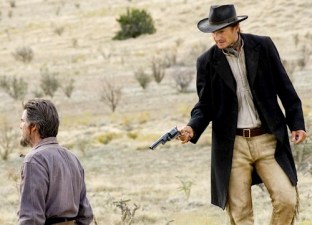
In practice, it makes for an unusual story. It’s centred neatly around Neeson chasing Brosnan, but the encounters they have along the way are increasingly bizarre. It’s readily apparent that there’s some Meaning and Subtext here, one that’s somehow related to religion (note the title; the missionaries; the destroyed Bible; the journey from somewhere high and calm, down through peoples of slipping moral standards, to the heat-hazy finale), but I’m not sure if one has to process this to appreciate the film — it’s a still a chase movie (of sorts) after all.

Indeed, one may not even notice all the allegories until Angelica Houston turns up, like some kind of inexplicable but convenient phantom, shortly before the final showdown. Who is she? What are her motives? What does it matter? (Her name’s a pun/clue, but I’ll leave that for you to notice/read on IMDb’s forum. Suffice to say, it fits with the other themes.)

Most characters are painted in quick sketches, and as soon as you get an inkling for who they are they’re dead or gone. The only exceptions are (of course) Neeson and Brosnan, who remain ambiguous for much of the film. The truth behind their chase is only revealed near the end, once most everyone else has fallen by the wayside. As the only constants, the various situations and their reactions allow the men to be slowly revealed. It’s not really a character piece, but they’re at least more complicated than your usual Good Guy vs Bad Guy setup — the story has you flip back and forth about which you think is which several times.
Subtly beautiful cinematography complements everything. Without being showy or overtly stylish, DP John Toll gets the most out of the film’s diametrically opposed locations: the lush, snow-drenched mountains of the first half, and the dry, barren dustbowls of the second, not to mention the burning autumnal tones of briefly-seen Seraphim Falls itself. Having caught this in SD, I look forward to watching it again on Blu-ray.

Though at times ponderously slow, the fact that Seraphim Falls contains an easily-understood driving plot alongside suggestions of a Deeper Meaning means it’s both accessible and relatively satisfying, even if its allegories pass you by. Conversely, the eventual dependence on these themes rather than a clear-cut finale may leave anyone who hoped for a straight chase/revenge story a bit miffed.

4 out of 5

Seraphim Falls is on BBC Two tonight, Saturday 9th August 2014, at 11pm.

The Chronicles of Narnia: Prince Caspian (2008)

2010 #47
Andrew Adamson | 150 mins | Blu-ray | PG / PG

The Chronicles of Narnia: Prince CaspianThe Pevensie children return to Narnia, but hundreds of years later, in Disney’s last adaptation from C.S. Lewis’ series (don’t worry, Fox have taken it over). For those keeping track, this is both the second book and second film, but fourth chronicle chronologically. Which is fine for now, but I wonder what they’ll do come those earlier-set ones…
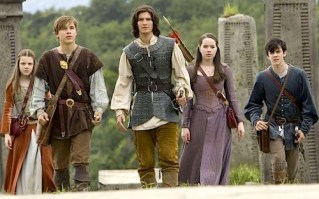
This time out, the world of Narnia has a harder edge. We’re still in PG territory — just — but everything’s turned a bit nasty, with a race of humans having wiped out the fantastical Narnians. Or (naturally) so they thought. Throw in some moderate political intrigue and you’ve got a more grown-up feel, if only slightly. It also makes for a slightly more cohesive tale — there are no odd elements leaking through from our world, like lampposts or Father Christmas, though one can well argue this removes something of Narnia’s unique magic.

It’s perhaps overlong, with numerous places trims could be made without denting the overall story. A half hour could surely have been saved without too much exertion. The first hour in particular is a tad slow, though the sometimes-wordy plot, based around some light court intrigue, adds depth beyond what might otherwise be a series of humans-on-magical-creatures punch-ups. I can’t comment on faithfulness here because it’s an awfully long time since I read the books. Besides, that running time is distorted by a whopping 12 minutes of end credits. I vaguely recall that, a few years ago, the second Matrix filmHeroes held the record for the longest closing credits at 10 minutes. I don’t really know what’s common these days but 12 minutes is nonetheless 8% of the film.

Once the human squabbling is passed — or by-passed, depending on your point of view — the human-Narnian war/one big battle really kicks off. Indeed, action sequences are frequent and fantastic throughout. The raid on the castle is tense, exciting and ultimately devastating — the troops left behind to certain slaughter is an incredibly dark moment in a PG-rated kids’ film. Later, a climactic sword fight is well staged, making excellent use of point-of-view shots, something I don’t recall seeing in a sword fight before.

The epic final battle comes as close to rivalling Helm’s Deep as anything I can think of, albeit — in typical Narnia style — in broad daylight on a big field. It has a real story to it, with specific moves being made by each side in the name of an overall strategy, rather than just A Lot Of Good Guys charging at A Lot Of Bad Guys and hacking away ’til one side wins, the apparent battle tactic in most other such large encounters on film.

The child actors aren’t going to set the world alight but are perfectly decent. I’m still not fully sold on Liam Neeson as Aslan, though I suppose the contrast of boom and gentility may be the point. Eddie Izzard is sadly underused as the excellent Reepicheep, who comes across as Narnia’s answer to Shrek 2’s Puss in Boots. Everyone else is fine — if nothing stands out, there is at least humour and an appropriate level of villainy provided.

Perhaps shortages such as this make the film a rather empty experience, as some have claimed. Not even titular new boy Caspian is treated to a huge amount of characterisation, and what little there is elsewhere depends wholly on knowledge of the first film. In fact, while the primary story largely stands alone, a proper understanding of it relies on the viewer remembering the previous instalment — at no point does anyone bother to explicitly explain that these kids we’ve just followed into Narnia are siblings, never mind that they were there before for decades as Kings and Queens. Maybe this is respecting your audience’s intelligence,Aslan or maybe it’s just counting on their memory a bit too much. With only limited characterisation and basic political complications, Prince Caspian really boils down to a series of fights and battles. Nicely done fights and battles, I’d argue, but still, no one’s coming away from this particularly enriched.

I was quite disappointed with the first Narnia in the end. It was entertaining and at times fun, but the primary-coloured bloodless climax in particular made it feel like Lord of the Rings Lite. I know I’m not alone in this — with the teaser poster for the next film, The Voyage of the Dawn Treader, coming out last week, I noticed a number of sites commenting that they’d not bothered with the second film after disliking the first; box office numbers were down too (though it’s still the 108th highest grossing film ever). Loyalty to a series I enjoyed as a child ensures my return (albeit two years after the theatrical release) but it’s a shame others chose to pass it by, because Prince Caspian is a step-up from The Lion, the Witch and the Wardrobe in pure entertainment stakes. Hopefully this tone continues into Dawn Treader and, fingers crossed, the four chronicles beyond.

4 out of 5

Waitress (2007)

2010 #31
Adrienne Shelly | 103 mins | DVD | 12 / PG-13

Whenever a star, director, writer, or other key creative dies during or around the production of a film, it’s apparently tempting to draw some kind of correlation between their death and the themes or content of their work. To force such a link between the murder of writer/director/co-star Adrienne Shelly and Waitress seems inappropriate, however, when the film is so much about life.
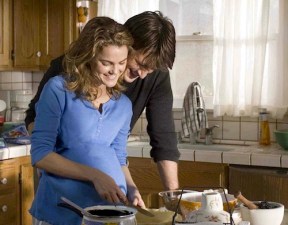
The basic plot could be made to sound identical to Juno’s, if one really wanted (I don’t though, so this won’t): Keri Russell (TV’s Felicity) plays titular waitress Jenna, a genius creator of delicious pies, who finds herself unwelcomely pregnant after a drunken night with her controlling, abusive husband Earl (Jeremy Sisto, TV’s Kidnapped). When Jenna visits her (female) doctor, she’s been replaced by (male) Dr Pomatter (Nathan Fillion, TV’s Firefly), an awkward, slightly bumbling man who, to cut the story slightly short, she falls for and they begin to have an affair — despite his being married (to fellow doctor Francine (Darby Stanchfield, TV’s Mad Men)).

Jenna tries to keep her pregnancy secret from Earl, with the support of her friends Becky (Cheryl Hines, TV’s Curb Your Enthusiasm), who has a secret of her own, and Dawn (Shelly), who’s being stalked by her one-time five-minute-date Ogie (Eddie Jemison, TV’s Hung). And she tries to keep her affair with Dr Pomatter secret from everyone, though it seems she can’t hide anything from perceptive elderly diner-owner Joe (Andy Griffith, TV’s Matlock).

Bun in the ovenI know I recently said I don’t give plot descriptions, but it’s these threads that illuminate Waitress’ life-affirming themes. Becky and Dawn show there’s hope for happiness with whatever hand you’ve been dealt, even where you least expect it; Ogie, Joe (and diner chef Cal (TV’s occasional guest star Lew Temple)) show you can’t judge a book by its cover; Joe also offers Jenna the gift of premature hindsight thanks to his reminisces and regrets; and then there’s the baby, who, aside from the obvious, represents fresh starts. None of these are hammered home quite as bluntly as I have here — not even the baby one — but my observations show, I suppose, what I took from them.

Though every performance excels, Shelly’s screenplay is the real star. To bring up the Juno similarity again, it features a quite idiosyncratic style of dialogue, particularly when delivered through the cast’s Southern accents. It’s also very funny, but never allows this to interfere with the more serious elements. Some have criticised it for putting so much levity near such tragic topics; I can only assume they live in a different world to our’s, presumably one where either everything is punctuated by a laughter track or one where everything is underscored by Coldplay.

From its promotional material and vaguest of outlines (Keri Russell leaves unhappy marriage for lovely Nathan Fillion!), Waitress looks like another breezy rom-com, the kind of thing that stars Jennifer Aniston — a chick flick, or to sound inappropriately less derogatory, “woman’s film”.Waitresses Waitress is a “woman’s film”, but in a good way: written and directed from a female perspective, with its central roles being female, it doesn’t pander to a perceived female demographic and nor does it bellow “this is what we women think, and it’s so different to you damn men” — it’s more subtle than that.
Kathryn Bigelow won the Oscar by beating men at their own game — and that was probably for the best as a first-timer, dodging accusations of “well, she just made a woman’s film, didn’t she?” from the off — but hopefully it’s nudged the door open for female voices on a wider range of subjects. To slightly go against what I said in that opening paragraph, it’s a loss that Adrienne Shelly won’t get a chance to be among them.

4 out of 5

The UK TV premiere of Waitress is on Film4 tomorrow at 9pm.
Waitress is on Film4 +1 today, Monday 28th July 2014, at 7:50pm.

Righteous Kill (2008)

2010 #46
Jon Avnet | 101 mins | Blu-ray | 15 / R

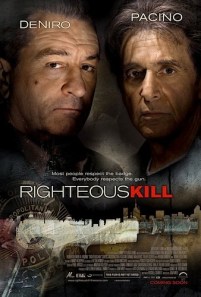
You remember Righteous Kill, right? It’s the film that reunited De Niro and Pacino, only the second time they’d appeared on screen together. And while the first, Heat, offered just one scintillating scene, Righteous Kill presented them as a police partnership — loads of scenes together! For a certain generation of film fans — several generations, probably — this just screams potential.

And what you’ll also remember is that it got slated. Thoroughly. Its Tomatometer is a measly 20%, and if you narrow that to ‘Top Critics’ — i.e. people/magazines that can usually be relied upon — it drops to a shockingly low 9%. It’s hard to find a good word said about it anywhere, although the pull quotes on Rotten Tomatoes are worth reading just to see Sky News’ contribution: in a field of quotes bursting with negative words, Tim Evans tries to assert not only that “it’s an effective whodunnit but — more importantly — it poses refined, complex questions about how the law operates in a so-called civilised society.”

Critics can be wrong, of course. It’s all a matter of opinion, and all that. But this time, they’re really not.

So what’s wrong with Righteous Kill? Well, it’s dull. Properly dull — not slow, not measured, not leisurely — just dull. Director Jon Avnet tries to spice things up occasionally with some swishy camerawork or editing, apparently forgettingKilled righteously he’s lensing a procedural thriller about a pair of 60-something cops and not Miami Vice 2. Suffice to say, it doesn’t work; if anything, it makes it worse.
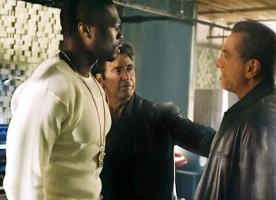
The plot is confused in its telling. Events appear to jump around with random flashbacks and forwards, but it’s actually mostly linear… except the scenes so disconnected that you’re left trying to work out what’s happening at what point even when it’s just happening in order. Screenwriter Russell Gewirtz was previously responsible for penning Inside Man, where a little of this kind of playing worked. Perhaps it’s Avnet’s fault, then; perhaps Gewirtz is a one hit wonder.

The film plays like a procedural/whodunnit as the cops try to work out who the serial killer might be. Except we know who it is from early on. Except Avnet muddles things so much that we’re not sure we know after all. Is this going to a be twist, just really badly hidden? No, it isn’t. So why not just own up to it and do a proper howcatchem, or psychological study, or whatever? Well, there is a twist, actually. But by the time we’ve worked out that we’re meant to know who the killer is all along, anyone passingly film literate will be beginning to realise there will be a twist — too many hoops are being jumped through in some scenes to cover up something we’re being explicitly told in others.

I’m trying not to give too much away here — goodness knows why, because I heartily recommend you never waste your time on this. Even if you can forgive the boringly convoluted plot, there’s nothing else to latch on to. The film’s at its best when focusing on the De Niro/Pacino pairing, granting us the occasional good scene. Or just line — every little helps. But there’s not enough of that and too much of the dross. Other characters come and go with near-random irregularity, subplots are abandoned, or if they were resolved I missed it, and there are so many clichés you wish the DVD came with a spotters’ guide — at least ticking them off would give you something to do.

There are good elements buried here, or at least passable ones. The twist, for example, could work beautifully if it had been executed better. Which is slightly ironic, because one gets the feeling many other choices in the story and direction were dictated by needing to make that reversal work. “Oops.”

Righteous Kill, then, is messy and largely dull, with the odd bit that makes you not totally regret giving it some time. Perhaps with the right team the good parts could’ve been marshalled into something broadly effective. In fact, I’m certain they could be, because there’s proof that at least the premise can work: it’s a TV series called Dexter. Watch that instead, it’s immeasurably better.

2 out of 5

Righteous Kill featured on my list of The Five Worst Films I Saw in 2010, which can be read in full here.