
 There are times when one feels under-qualified to review a film in a way that gives it its due. This happens particularly frequently when one’s blog covers first-time viewings of films that are often classics/significant/beloved/etc. My appreciation for Exiled has been increased by two other, more qualified, reviews: one from DVD Times, the other from Heroes of the East.
Having never seen a Johnnie To film and not being sure quite what to expect — either from the director or from what appeared to be a gangster/action film being shown on arts-centric BBC Four — my first reactions to Exiled were a little muddled. Having pointed you in the direction of those other reviews — which I should say I agree with, in the sense that they’ve changed my perspective on the film and leave me with a desire to see it again in light of their comments — I’ve decided that, instead of my own review that tries to conglomerate my initial thoughts with the additional perspective I’ve since gained (and which is best presented in those other articles), I’ll once again turn my notes into sentences and offer it up for your consideration.
The length of the sentences and clauses in the above paragraph suggest I’ve read too many academic essays in the last 24 hours, so I’ll just clarify: What follows are, essentially, my notes after first viewing. I’m not wholly in agreement with some of it anymore; with the exception, of course, of the score.
Exiled features several impressive action scenes. They’re Leone-like in the way there’s often an extended pause, the threat of violence hanging in the air — then a sudden burst, over quickly. But within this style there’s a lot of visual flair — unlike Leone, slow motion makes the moments last minutes, underlined by the entire climatic shoot-out taking place in the time it takes for a can of Red Bull to be kicked in the air and drop back down. As many a teenage boy watching would no doubt say, “cool!”
Elsewhere in the coolness stakes, Anthony Wong owns the sunglasses-and-trenchcoat look, appearing as a cross between a middle-aged businessman and a stylish hitman. Francis Ng looks equally cool, but in a more ‘traditional’ way. Quite what the ‘cool’ aesthetic does for the film/story/characters I’m not sure, other than increase its accessibility.
Dialogue is kept to a minimum, appropriately. Whole character arcs and motivations pass by without a word of explanation, allowing the viewer to fill in the gaps. It works just fine — there’s no need to spell them out, and they’re not so obscured as to be baffling. There’s an audacious twist around halfway through, which removes the apparent point of the plot and suggests it’s all really about something other than the obvious. [This in itself should be a sign that a lot of what follows in my comments is rubbish…]
Is the story just an excuse to link the spectacle of action? [This, I think, is where my notes really lose the plot.] Yes and no. The story is hardly revelatory, nor is there a great deal of character exploration (or any, in most cases) to suggest To is aiming for a different angle on a familiar tale. But while the action set pieces are exciting and visually engaging, they’re not so unusual as to suggest someone conceived of them and then a story to connect the dots. Is it style over substance? [No.] Again, to an extent. I suppose there’s not a great deal of substance, and there is quite a bit of style; though, again, the latter isn’t as show-off-y as style-over-substance films usually are.
Alternatively, I suppose the plot is quite shallow [it isn’t really]: even things that suggest stories and development — such as Boss Fay weighing in on Boss Keung’s territory — don’t really develop into much, instead becoming a backdrop for who’s shooting at who when.
Whatever it is, it’s entertaining. Especially if you like people shooting at each other in cool ways and gangster-based thrillersome plots.
Note the dramatic device of the photos [which, I think, in themselves disprove my ponderings that the film lacks depth]: the first shows the characters when young, at the beginning of their ‘career’; the second is at the start of this story, effectively being the midpoint/bulk of said ‘career’; and the last one is at death, the end of this ‘career’ — though it’s the same group in each, they’ve all changed between every photo, even the last two taken just days apart. It’s a relatively subtle but effective motif.
So much for my unadulterated notes. Anyway:

Director Johnnie To’s 2012 film Drug War is on Film4 tonight, Thursday 15th January 2015, at 1:15am.
* BBC Four showed this in 16:9, but the OAR is 2.35:1 — and it showed, with compositions often looking cropped. Shame. ^
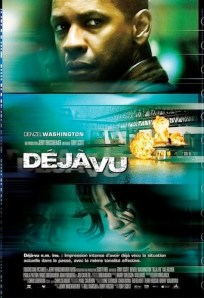 Denzel Washington and Tony Scott have now served as star and director (respectively, as if you didn’t know) on four films, with
  First, a little note on that aka: technically — and, I believe, legally — no such title is attached to this project. However, the initial idea was developed by Koontz and, after he left the project, adapted into his Dean Koontz’s Frankenstein series of novels. Despite the ‘creative disagreement’ (or whatever they chose to call it) that led him to walk away, the film retains significant similarities to the first book. More on these in a moment.
 M is a film of immense significance, not least because of its place on
  the public reaction and hysteria; the police’s flailing investigations and increasing exasperation; the criminal underworld, who begin their own manhunt because police inquiries are “bad for business” (despite sounding like a filmic conceit, this element was directly inspired by a newspaper article); and the criminal himself — trying to lay low, but constantly having to fight his urges… and ultimately giving in to them again.
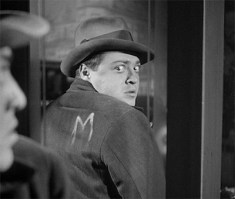 how they search crime scenes with a fine-tooth comb; another sequence shows their methodology for staging a raid; and so on. Such precise and clinical methods ultimately pay off: it’s a pair of tiny clues, carefully reasoned and sought out, that reveal the killer’s identity — and if it weren’t for the criminals getting there first, they’d’ve surely caught him too. Indeed, were it not for this breakthrough then the film might hold a
  like tracking from outside to inside through a window within a single shot — are present here). M’s individual moments of brilliance go on — perhaps my favourite is when the police arrive just after the criminals have apprehended Beckert. We don’t even see an officer on screen, but the burglar’s reactions let us know who’s there. Its a funny moment (even if we’ve seen it dozens of times since) and a lovely shot too.
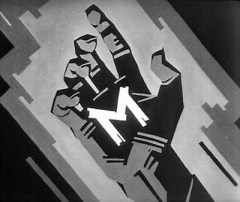 the murderer won’t bring the children back, and warns viewers to watch out for their own. It’s not the triumphant “we got him!” that concludes most serial killer films, but a blunt warning that, though Beckert has been caught, there are always more out there, waiting to strike. History has sadly proven her right; but while the world has produced many men and women like M’s villain, it hasn’t produced many films quite like M.
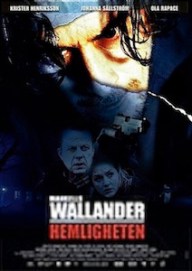 The third theatrical release to star Krister Henriksson as Henning Mankell’s detective is the thirteenth and final episode in the first series. It has a suitably Season Finale feel to it — “this time it’s personal” and all that — but also subtly constructs itself to work as the standalone piece necessary for a theatrical release schedule that skipped six whole episodes.
 Harrison Ford stars as President Indiana Jones — sorry, Jack Ryan — no, James Marshall (that’s it) in this action-thriller from the
  100Films.co.uk