Murder on the Orient Express (1974)

2009 #94
Sidney Lumet | 122 mins | TV | PG / PG

Murder on the Orient ExpressMurder on the Orient Express is arguably Agatha Christie’s most famous novel, perhaps because of its widely-known twist ending, or perhaps because it’s inspired in part by a high-profile true story, or perhaps because of this multi-Oscar-nominated all-star adaptation.

The plot is the stereotypical Christie set up: a group of fairly well-off people find themselves in a confined setting, one is killed, a sleuth works out who. This time it’s a train rather than a luxurious mansion, but the basics are there. This isn’t a criticism — I enjoy a good Christie adaptation as much as everyone else who’s kept the current TV incarnation on air for 21 years (and counting) — and here at least Christie has a number of twists to her usual style. As mentioned its launching point is a true story, the Armstrong kidnapping and murder being based on the Lindbergh kidnap of 1932 (just a couple of years before the book was written); the snow-bound train’s location (very apt after our recent weather) is certainly different to a stereotypical country estate setting; and then there’s the infamous ending.

I won’t spoil it here, just in case anyone doesn’t know it. Some are very critical of this particular denouement, labeling it an unsatisfactory cop-out that doesn’t make sense. Neither of these things are true. It is not reliant on an extraordinary coincidence — it might look that way at first, but the full explanation reveals it to be anything but — and there are numerous clues along the way as to what it might be, even if some are more thematic than the actual red herrings that almost lead Poirot astray. It’s a shame that knowledge of the ending is quite widespread these days, though that’s perhaps inevitable for a 76-year-old story. Still, I’ve done my bit.

In the lead role, Albert Finney’s Poirot may have received an Oscar nomination and, more importantly, been approved by Christie herself (according to some; according to others, she wasn’t impressed), but he now pales in the inevitable comparison with David Suchet’s definitive portrayal of the Belgian detective. Suchet has defined Poirot in a way few other major franchisable characters have been (Connery may be widely accepted as the best Bond, but there are plenty who’d choose Moore, Craig, Dalton and Brosnan, and you may even find someone who likes Lazenby; equally, Sherlockians may divide themselves between Rathbone and Brett, not to mention Cushing and hundreds of others). He has the advantage of being able to perfect the role across hundreds of hours of television, but nonetheless stands proud as the high-watermark that others can only try to reach (even those who played the role 15 years earlier).

Finney’s version is more obviously comical than Suchet’s. Where humour in the latter is derived from his serious fastidiousness, Finney plays it more for laughs; where Suchet seems almost solemn in his investigations Finney frequently bursts into laughter. It’s a broader interpretation of the character, one that ultimately lacks subtlety. At least Finney is thoroughly subsumed in the role, which means that after a while one does become accustomed to it.

The rest of the cast are well suited to their roles. Ingrid Bergman won the Best Supporting Actress Oscar for her role, though one wonders if it was a weak year for the category as her part is miniscule and not particularly memorable. Elsewhere, famous names such as Lauren Bacall, Sean Connery, John Gielgud, Michael York, and many more, round out a truly star-studded ensemble where each has but a small part to play. It must be relatively easy to attract big names to Christie adaptations — as the TV series still do — when the author is so beloved and the amount of time required to shoot is (for a guest star) so small. Best here, perhaps, is Martin Balsam as Poirot’s friend Bianchi, who’s treated to several good scenes, not least the series of interviews where after each he confidently declares “it was them!”

As a standalone film, Murder on the Orient Express is a skilled effort (I can’t comment on its quality as an adaptation because I’ve never read the book). For a viewer so familiar with Suchet’s interpretation of the character, however, even an all-star cast can’t quite remove the feeling that it’s not quite right. The Suchet-starring adaptation of this particular case has been filming recently, hopefully for broadcast later in 2010 (though knowing ITV we could have to wait as long as 2012), but even though it’ll have the definitive Poirot leading its cast, this film leaves a lot to live up to.

4 out of 5

(Originally posted on 15th January 2010.)

The Gruffalo (2009)

2009 #89a
Max Lang & Jakob Schuh | 27 mins | TV

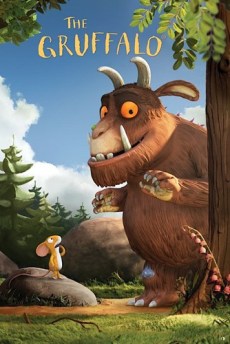
The GruffaloJulia Donaldson and Axel Scheffler children’s book The Gruffalo was a bit after my time but, I’m told, is incredibly popular with The Youth Of Today (not the ones that hang out on street corners earning ASBOs, obviously). It’s certainly a pleasant read, with rhythmic poetry and the kind of repetition that allows children to join in with ease, but it’s also quite short — fine for a children’s book, but not so good for attempting a screen adaptation of any length.

Having turned down numerous offers for feature-length versions, Donaldson accepted the half-hour short film treatment. Thank God she did, because even at under 30 minutes there’s some padding in evidence. There’s a brief bookend narrative featuring some squirrels, plus a leisurely pace throughout that takes in the scenery and wildlife of the forest world these character inhabit. Seeing a segment in isolation the film can look far too slow, with uncomfortably long pauses between each line of the original verse. As a whole, however, the viewer settles into its style and it rarely if ever feels forced.

The CG animation is well pitched. The textures and style at times left me wondering if the film was actually stop-motion animation, and consequently it carries the warm, cosy, intimate feel that such productions achieve and CGI almost universally fails at (even from Pixar). Whether it was the intention to emulate claymation or just a side effect, it’s certainly more effective than the work on Flushed Away, Aardman’s first CG outing that deliberately set out to look like their traditional stop-motion.

The voicework is equally spot on. John Hurt sounds fabulous in anything, Rob Brydon’s vocal changeability lends appropriate sibilance to the snake, it’s difficult to imagine anyone other than Robbie Coltrane providing the monsterly tones of the titular beast, and even James Corden fits as the mouse. Tom Wilkinson and Helena Bonham Carter also do fine work, meaning there’s not a weak link among them.

Despite being primarily aimed at kids — who hopefully won’t struggle too much with the languid pace — the very listenable poetry of the text and hand-made look of the visuals provide much for older children and adults to enjoy as well. Super.

4 out of 5

The Gruffalo can still be seen on the BBC iPlayer until 7:29pm today. It is also available in HD.

(Originally posted on 2nd January 2010.)

Where the Sidewalk Ends (1950)

2009 #70
Otto Preminger | 91 mins | TV | 12

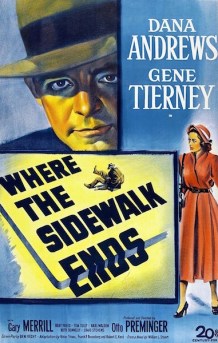
Where the Sidewalk EndsOtto Preminger’s film noir — scripted by Ben Hecht, adapted from William L. Stuart’s novel by Robert E. Kent, Frank P. Rosenberg and Victor Trivas, and quite what the difference between “adapting” and “writing” are I’m not sure — offers complex characters in a multi-layered plot. The ending particularly underlines this: the filmmakers could’ve killed anti-hero Dixon, could’ve had him choose to not open the letter, etc; but the decision he takes and the reactions of others are all relatively complex. Earlier, the sequences following Paine’s death are well constructed to produce the maximum amount of tension; their plotting clever, allowing for multiple (albeit similar) interpretations of events. Things happen which seem irrelevant, but are of course none-more-relevant later. Few films today are so brave as to not explain such things immediately.

There are lots of great scenes like these — look at the single scene featuring Klein and his wife, for example. It doesn’t have to be there — Klein could’ve just given his partner the cash — but for the sake of one short scene we get two proper characters. Yes, they’re quickly and sketchily drawn, but believable with it. The same goes for the old woman listening to the radio — does it matter that her husband’s dead, that she sits there for company, which she only gets because Paine always waves to her? Not particularly — but that it is there really adds to the film. Even the crooks get similar treatment, tiny elements (such as one character’s parole) progressing and returning, almost insignificant subplots that all have a place and function in the greater story.

Dana Andrews is an effective lead, believable as Dixon the thuggish cop. We support him, but only just — he doesn’t quite have the instant likeability of Bogie’s Marlowe, for example, but he’s enough on the side of right that we can get behind him. Gary Merrill’s Scalise is an appropriate villain. He’s not in it much — a little at the beginning, a little at the end — but he permeates the film to a degree, the uncatchable boss just out of reach, who Dixon wants to pin everything on.

All the other performances are good too, but perhaps most memorable is Karl Malden as newly-promoted Lt. Thomas. He’s both good at his job and bungling — for example, he creates a completely plausible theory of how Jiggs did the crime, convincing all around him; but the viewer knows how incorrect and circumstantial it all is, which makes Thomas look slightly bumbling even when he’s apparently on to a winner. Malden doesn’t make him too silly or bungling — he could be like Nigel Bruce’s Watson, for example — but nor does it go too far the other way, making him so hardline that he becomes a villainous figure. It’s a fine line that Malden negotiates with skill.

I really enjoyed Where the Sidewalk Ends, perhaps more than I expected to, and I should say it narrowly missed out on my 2009 Top Ten.

5 out of 5

Harry Potter and the Half-Blood Prince (2009)

2009 #84
David Yates | 153 mins | Blu-ray | 12 / PG

Harry Potter and the Half-Blood PrinceBy this point I imagine everyone has a pretty clear idea what they think of Harry Potter, and this latest film certainly isn’t going to change that. That’s not to say it’s bad — in fact, it’s rather good — but Harry Potter is what it is, and nothing’s going to change that, least of all these thoroughly faithful adaptations.

This particular entry is well adapted from its huge source. I remember the novel as being somewhat turgid, a 600-page slab of flashbacks and exposition provided so one could understand the events of Deathly Hallows (for the uninitiated, that’s the final book, arriving as two films in 2010 and 2011). Thankfully, returning screenwriter Steve Kloves (who has adapted every Potter bar the previous one) and director David Yates liven it up considerably.

Adapting a 600-plus-page book is always a gargantuan task, something the Potter series has struggled with before (at times, Order of the Phoenix felt like an hour-long highlights montage), but Kloves manages to keep the thrust of the dark primary plot while peppering it with humour- and romance-based asides. (Calling it ‘romance’ may be a little generous — ‘teenage snogfest’ seems to be the preferred term by critics. And it is that, really. But ‘snog’ is such an ugly word, so I shall stick to ‘romance’.) The film could have been all Dark and Grim — and people doubtless expected, and probably would have accepted, that — but the sizable amounts of humour and romance keep the tone more appropriate to the series’ kid-centred roots, as well as adding light to the shade in a way that should please everyone. The titular Prince, however, is barely a subplot, but that’s a flaw of the novel rather than Kloves’ work.

Yates pitches the humour right, though the romance is occasionally overbearing for my taste, but the action sequences are well handled. Unfortunately, while entertaining in their own right, the majority are an aside to the main plot, which is perhaps where the two-and-a-half-hour running time comes from. The return of Quidditch is welcome to some fans, but would surely have been dropped without the fan pressure. That said, it feeds into both the Luck potion and romantic subplots, as well as providing its own doses of humour and action. Still, it’s a missed opportunity to further establish the character of Katie Bell, who has a moderately significant part to play a bit later on.

Worse is the opening bridge attack, which feels fairly pointless. Again, in itself it’s a dramatic event, expanded from a passing reference in the novel, but it bears little relation to the rest of the plot. In the novel it has a point — the wizarding world is finally impacting on the normal one — but that thread remains unexplored by the rest of the film, rendering the opening a visually exciting but empty sequence.

The still-young cast are intermittently believable. Rupert Grint still has a talent for comedy — enough to fulfill his role here, anyway — while Tom Felton is finally treated to a decent part as Draco. Formerly just an irritating bully, here he has a larger and more complex part to play, allowing Felton room to become one of the few child actors who can still live up to their part now. The adults are excellent as ever, particularly Jim Broadbent in a guest-star-level part and, naturally, Alan Rickman, who remains underused but may yet be treated to some material worthy of his talents in the final films. Additionally, Julie Walters conveys more with one expression in her brief cameo than some actresses can manage with half a dozen scenes.

With numerous plot elements left brazenly gaping ready for the next instalment (just as in the novel, of course) — including at least one thrown into the mix in the closing seconds — and Yates’ promise of an ‘urban thriller’ style for at least Part I (a genre he mastered in the outstanding State of Play), the two-part Deathly Hallows is a relatively tantalising prospect. Just eleven months to go…

4 out of 5

Avatar [3D] (2009)

2009 #89
James Cameron | 162 mins | cinema | 12A / PG-13

AvatarAvatar is The Film That Changed Cinema. The past tense can safely be used, despite the film only having been out a couple of days — it doesn’t matter if we like it, filmmakers and Hollywood executives have decided it’s the artistic and commercial way forward, and so it shall be. It barely even matters if people actually go to see it; not that it’s in much danger of flopping, coming in the wake of years of extreme hype and numerous sycophantic reviews.

What’s almost more irritating than that, however, is that it’s actually quite good. Flawed, unquestionably, and probably undeserving of the volume of advance praise heaped upon it, but far from a disaster.

It’s too long, for one thing. The end of Act Two feels like the end of the film… until it insists on going on for goodness-knows how long (my watch stopped working, I couldn’t check). It might not be so bad if it didn’t take its time getting to this point. Swathes of it feel like a dramatised nature documentary, only this time it’s about a fictional alien world. Talk of Cameron having created a fully-realised, living, breathing ecosystem are over-egged: there’s a half dozen creatures, at most, and their only relation is that they have these weird tentacle things in their hair that allow them to connect up to one another, like nature’s own biological USB. Maybe he knows who eats what and when and how and mating rituals and all that jazz, and if he does we should be thankful it’s not plastered all over the screen, but the creature creation/world realisation here isn’t anything beyond Jurassic Park.

The story itself isn’t bad. It certainly has an epic quality, which at least justifies the running time, though it’s a collation of elements from elsewhere. Of course, such things can be said of most stories these days, but with Avatar it seems even more obvious — a bit of Aliens here, a bit of The Matrix Revolutions there, a bit of An Inconvenient Truth for good measure, and so on with countless other recognisable tropes. The sin Cameron commits is that he mostly does it in quite a clichéd manner — it’s not just that you have seen it before, but it feels like you have too. Even the learning-to-fly bit, much praised in some quarters, reminded me of something else: slightly-rubbish TV miniseries Dinotopia, of all things. And don’t get started on the dialogue — “Try not to think of anything. That shouldn’t be too hard for you.” Dear God, how many times have we heard that line?

Towards the end Cameron does pull a few things out of the bag, mainly involving who gets killed and who doesn’t. Mostly, the story is a framework to allow the visual spectacle and an ecological/anti-war message. It’s as subtle as a nine-foot-tall blue alien. From crystal clear uses of familiar phrases like “shock and awe” and “hearts and minds”, to unconcealed references to our dying planet, Cameron attempts to criticise both American military tactics (invade, crush the locals…) and the destruction of the planet (…take all the natural resources for ourselves, no matter what the cost). It’s not that the message is wrong, it’s just that Al Gore did it with greater subtlety in a 90-minute lecture on that specific subject. From the outset, the military — specifically marines, of course — are quite clearly The Bad Guys Here, which is a refreshing change from the man who brought us Aliens. Quite what the American public are/will make of this outright criticism of both its military and energy consumption remains to be seen.

All this is realised through unrelenting CGI. It’s very good, but here Avatar falls victim to its own hype once again, because it’s still not 100% perfect. Perhaps it’s the closest yet seen — it certainly remains consistent throughout — but nothing had me wondering if they’d perhaps used prosthetics in addition to the CGI, as Davy Jones did at several points during Dead Man’s Chest, and I remain convinced that wonderful modelwork, as seen in the likes of Lord of the Rings, is still an unbeatable tool for creating convincing environments. Some will argue that we remain unconvinced of the alien creatures’ authenticity because we know they can’t be real, but some occasionally exhibit the plasticky shine of CGI or the jerky movement of motion capture. The Na’vi are certainly a step up from Robert Zemeckis’ dead-eyed humans in The Polar Express or Beowulf, but are they that much better than Gollum? Or even Jar Jar Binks? (In terms of the competency of the effects, I hasten to add.)

It’s hard to resist flaw-spotting with Avatar after reading so many praise-filled reviews. At the risk of sounding like one of those irritating people who sits at their keyboard declaring “ah-ha, I’ve realised something all you professional reviewers weren’t clever enough to see!”, I think this is in part due to the final act. Avatar has a stonking finale, from a huge Apocalypse Now-styled 9/11-echoing moment of destruction, to a thrilling and epic final battle (albeit interrupted by a mass of unwelcome pace-challenging plot). These sequences excel on almost every level, from visual wonder to the odd spot of emotion. And this is what your final impression of the film is, which can banish memories of the crawl through the middle, replete with those niggling flaws. I won’t be surprised if DVD/Blu-ray reviews commonly lose a star, robbed as it will be of the huge screen spectacle and reviewers forced to remember what they had to sit through to reach the big climax.

Oh yes, and Avatar’s meant to be convincing us that 3D is the future, isn’t it? And actually, 3D is quite nice. This is the first time I’ve seen a film in RealD, so I was pleased to discover how perfectly it works. No ghosting that I noticed and minimal discomfort even after such a long film, so from a viewing point of view I was happy with it. It adds depth to the image as well, rather than throwing things in your face — this too was pleasant. As I’ve noted on previous 3D reviews, this depth can bring a scene to life… not in the sense that you believe it’s genuinely happening behind that screen in front of you, but it does liven the images up.

What it doesn’t do is improve the storytelling — but then, what does? Some actors in a black box can convey a story wonderfully — look at Dogville, or any number of theatre productions — you don’t need sets, or costumes, or CGI, or even music or any number of other things we associate with the film experience. You could lump 3D in with these, or you could say it’s even less necessary — sets, costumes, and all evoke a time and place and create a realistic world in a way a black box doesn’t, but what does 3D bring to the table? It’s purely about spectacle, in the same way CGI or helicopter shots or using IMAX usually are. And that’s fine. But directors who’ve expressed an interest in shooting a ‘normal’ domestic drama in the format may be overestimating its import.

But for all the derivative plot, blunt message, cheesy dialogue, thrilling action, spectacular imagery, pretty good CGI and debatable 3D, Avatar may have a greater problem in gaining anything like widespread acceptance. It’s set 145 years in the future, on an alien world with floating mountains and other such fantastical elements, where a significant chunk of the story centres on a group of nine-foot-tall aliens (who fall in love and kiss, much to the loud derision of a group of 13-year-old boys in my screening) in a weird alien jungle with prehistoric-like alien creatures, and semi-scientific religious imagery and plot points that I haven’t even touched on… It’s pretty hard science-fiction, to put it simply. It’s not the accessible historical romance/disaster of Titanic, it’s not the real-world-styled action-based superheroics of The Dark Knight, it’s not an accessible adaptation of a widely-loved book like Lord of the Rings or Harry Potter… One could go on in this vein through all the highest-grossing movies of all time.

Instead, it’s the cover art from a pulp science-fiction/fantasy novel or short story magazine writ large with the budget required to pull it off, and it’s that for almost three hours. For every SF/F-loving sycophant there’ll be a member of the general public who thinks it’s a load of old tosh. The truth is somewhere in between, as ever, but I won’t be surprised if the style of Avatar’s business is closer to Watchmen than Titanic. (I don’t think this is too delusional, incidentally. It will perform more strongly than Watchmen, obviously, because it has that all-important PG-13 certificate in the US and a helluva lot more hype in the mass media. But I remain convinced it won’t manage to be a phenomenon to rival Titanic or The Dark Knight, or The Lord of the Rings, or Harry Potter or Pirates of the Caribbean or Star Wars.)

Avatar is a significant film. Thanks to the hype and importance attached to it, by both Cameron and the industry at large, this can never be taken away from it — even if we’ve heard its story before, seen 3D before, seen effects as good before. I don’t believe The Future Of Film is riding on it as much as some would claim — after all, so convinced are They of its status as a hit that an endless stream of 3D movies heavy on CGI have arrived ahead of it and will continue for years after. In itself, it’s quite entertaining and probably deserves to be seen on the big screen. But, as expected, it’s not the revolution that was promised.

4 out of 5

Blade Runner: The Final Cut (1982/2007)

2009 #58
Ridley Scott | 118 mins | Blu-ray | 15 / R

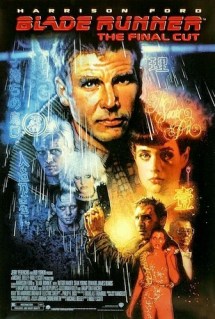
Blade Runner: The Final CutYou don’t need me to tell you about Blade Runner. It’s one of the most popular movies ever, if not with a mass audience then with a significantly-sized cult following and even wider-spread respect. Still, I’m going to go on about it for a bit anyway.
First off let me say that I have seen it before, in the guise of its 1992 Director’s Cut, the only cut available on Home Entertainment/TV since I’ve been old enough to know the film exists, and which is surely to blame for almost every blockbuster getting a Director’s/Extended/Unrated/Ultimate/Complete/etc Cut on DVD these days. Ironic, really, considering it’s a slight misnomer as Ridley Scott wasn’t properly involved with its creation. The Final Cut isn’t fundamentally different to that Director’s Cut, however. Yes, there are an array of editing tweaks and myriad effects fixes, but the meat-and-bones of the story and the content of the scenes — including the removal of the voiceover and the foreshortened ending — remain the same as the Director’s Cut. (If you’re interested in a blow-by-blow account of all the differences between the five cuts now available, try here.)

Normally such minor surface changes wouldn’t warrant a new number on this blog. But this is Blade Runner — or should that be Blade Runner, undeniably one of the most significant films of the last quarter-century thanks to its enduring influence. Yes, it is heavily influenced itself — by the likes of Metropolis and the whole of film noir, primarily — but its dystopian future — all constant night-and-rain, busy streets, neon advertising, canyon-like decrepit skyscrapers towering over dirty streets, high technology rubbing with the everyday detritus of humanity — has been copied everywhere. Without this there’d probably be no Ghost in the Shell, no Dark City, no Matrix, no re-imagined Battlestar Galactica, no thousand other things that have nothing close to the brains but do have the look, the style, the feel. Not to mention Red Dwarf: Back to Earth, of course (he says, as if that has greater significance than the rest!), which sits somewhere between homage and rip-off, surprisingly large chunks of it making almost no sense without at least a passing familiarity with Blade Runner. And the whole thing’s cyclical, because look how The Matrix has gone on to influence countless other lesser efforts. But that discussion is for another time.

In fact, the film can also be seen all over the real world, in what is doubtless the skill of those who predicted its future rather than a genuine influence on Real Life (though you can never be sure). It’s not all true, obviously, but for all the outdated technology (look at the computer displays!) or never-likely technology (flying cars!) there’s an example of the way the world’s headed or already gone. Video phones? Look at Skype, or video inboxes on the iPhone. LA’s skyscrapers, gaudy neon signs, huge video-screen advertisements, rundown areas of the city that are so unrestored they seem to be from decades ago (because they are), the increasingly widespread integration of Eastern culture, photo manipulation available in the home to anyone… it, and more, is all already here, or just around the corner.

But being Surprisingly Accurate does not a popular film make (well, not necessarily), and so of course Blade Runner has a lot more to offer than “ooh, I can do that too!” Putting the future setting aside for a moment, it’s plain to see that the film is as shaped by film noir as by other sci-fi, if not more so. The dark cinematography is perhaps the most obvious area of influence: shafts of light breaking up shadows; imposing cityscapes; constant rain, constant night (with any daytime scenes stuck indoors, often with blinds drawn and/or the light made hazy by smoke). There’s the plot too: it’s packed to bursting with sci-fi concepts underpinned by metaphysical discussions (who is God? what does it mean to be human?), but these are driven by a pure noir narrative, complete with beaten-down reluctant detective (who even loses the final fight), a femme fatale, a questionable moral perspective and a storyline that is predicated on an investigation/manhunt.

That this tale unfurls at a relatively slow pace is surely not to everyone’s taste, but it suits the film’s somewhat intellectual bent. The pacing renders it majestic, stately, both thoughtful and thought-provoking. Even the action sequences tend toward this. This overall languidness frequently allows moments of beauty to leap out, from the visuals, the ideas, the dialogue — Batty’s dying words, for example, are beguiling, elegant and meaningful, mixing the fantastical with an identifiable reality to memorable effect.

The image that most stands out is, appropriately, eyes: the V.K. test, the occasional orange glint in Replicants’ pupils, Batty squeezing out Tyrell’s eyes, the latter’s huge glasses, Pris’ spray-painted eyeliner, Gaff’s odd-looking eyes, and so on. It succinctly reflects the themes of what things seem to be and what they actually are — “seeing is believing”, if you will, although in Blade Runner’s world that clearly isn’t true. The famous photo manipulation scene also feeds into this. One of the great things about the eye motif is that you can’t exactly miss it — the very first thing seen is an extreme close-up of an eye — but it’s obvious not in a batter-you-round-the-head-so-even-the-most-simple-simpleton-will-notice way, but the if-you’re-an-intelligent-viewer-you-shouldn’t-fail-to-spot-it-on-a-repeat-viewing kind of way.

Elsewhere in the filmmaking pantheon, the specials effects are astounding. They look brilliant today, easily besting most of the still-obvious CGI we’re bombarded with. Yes, they’re now aided by some digital clean-up, wire removal and that kind of thing, but the basic models and composites remain untouched and are beautiful. Similarly, Vangelis’ score should by all rights sound dated and discordant, filled as it is with early-80s synths. Fortunately, it has a kind of unusual beauty that matches the visuals it drifts over, complementing as it should rather than providing an uncomfortable reminder of exactly which decade produced the film.

Blade Runner is by any count an incredible piece of work (something the extensive making-of documentary on The Final Cut DVD/BD only emphasises, incidentally). Not everyone will (or does) like it, but I should imagine even they find it hard not to admire (an altogether different thing to “like”). Either way, I think it’s safe to say it can lay claim to a place on the relatively select list of films everyone really must see.

5 out of 5

BBC Two are showing Blade Runner: The Final Cut tonight at 9pm.
Blade Runner: The Final Cut is on BBC Four tonight, 26th September 2013, at 10pm.

I covered the 1992 Director’s Cut as part of my 100 Favourites series, here.

The Thief of Bagdad (1940)

2009 #66
Ludwig Berger, Michael Powell & Tim Whelan* | 102 mins | TV (HD**) | U

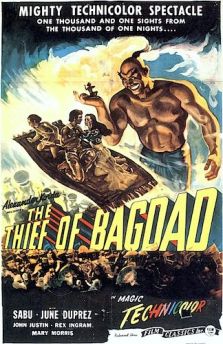
The Thief of BagdadThe Thief of Bagdad is, in many respects, one of the forefathers of the modern spectacle-driven blockbuster, packed with innovative effects designed to dazzle the viewer. One can only imagine how incredible the special effects looked to a 1940 audience. Today the flaws are obvious, but, surprisingly, not by much.
There are too many enchanting sequences to mention — the ginormous genie, the flying mechanical horse, the giant spider, the toys, the flying carpet… Models, huge life-scaled props, matte paintings, early blue screen — all this and more are put to use beautifully. The ingenuity of the effects work contains more artistry and charm — and, frequently, more excitement — than the bland, wannabe-perfect CGI we’re force fed today; and, because of this, and in spite of being almost 70 years old, the sense of wonder remains. It doesn’t matter that it’s not 100% believable — in fact, that’s almost the point: the child-like ability to suspend one’s disbelief and accept the fantastical seems to be the message of the film (or, at least, one of them).

All of this is emphasised by the cinematography. This is one of the earliest films to use Technicolor and use it it does. Everything is vibrant and lush, vivid and otherworldly; especially to the audience of the time, I should imagine, not accustomed to foreign holidays and endless TV travel shows as we are today. But the film’s world is a heightened version of reality and, as with the effects, the fantastical style means it doesn’t really date. Wish You Were Here has nothing on this.

The story itself has a bit of everything: romance, fantasy, action, adventure, humour and, no doubt, more. The cast are up to the task, with John Justin swashing his buckle Errol Flynn-style as dethroned prince Ahmed; Conrad Veidt perfect as slimily evil vizier Jaffar “the usurper”; Sabu suitably valiant, amusing and clever as a peasant hero; and Rex Ingram making a memorably self-centred genie. If Disney fans think some of this sounds familiar, it must seem obvious to anyone who’s seen Aladdin that The Thief of Bagdad was a major influence on the 1992 animated classic.

These days, The Thief of Bagdad may be something of an acquired taste — some viewers will struggle to engage their sense of make-believe enough to accept the rough-round-the-edges effects and fantastical storyline — but that’s their loss, quite frankly. For those of us with some imagination to spare, it remains a magical experience.

5 out of 5

* Although only these three are credited on screen, six directors were reportedly involved. The others were producers Alexander Korda, Zoltan Korda, and William Cameron Menzies. ^

** Though listed by the Radio Times as being in HD, the D didn’t look particularly H to me. ^

Fatal Instinct (1993)

2009 #86
Carl Reiner | 90 mins | download | 15 / PG-13

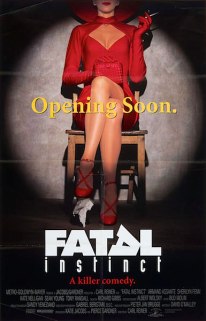
Fatal InstinctHaving just recently laid into High Anxiety, a spoof in a broadly similar style that also took on thrillers, it seems a little hypocritical to praise this, which flopped so badly in the US it went straight to video over here. Unfortunately, life isn’t that simple, and where Mel Brooks’ effort failed to amuse me this succeeded.

The plot, such as it is, doesn’t bear much discussion, being a loose amalgamation of half a dozen other films in the name of spoofery. So too the performances — no one distinguishes themselves as a comedic genius, but none let the side down. Reiner’s direction is equally fine, setting up and paying off the visual, verbal and aural jokes perfectly well. He drops the ball in a couple of instances however, allowing several jokes to run on well past their natural conclusion, and indulging in a few well-worn staples of the genre — the on-screen-musicians-playing-the-score turn up, for example, although at least there’s a nice variation at one point involving a tape player.

It’s a little difficult to understand exactly why it flopped so badly in the US as it followed in the wake of the similarly-styled Hot Shots!, which was successful enough to spawn a sequel. But then perhaps exactly that hindered it — Fatal Instinct’s release came just a few months after Hot Shots! Part Deux.

Or perhaps its targets were just too broad to attract a mass audience. While it ostensibly tackles then-recent thrillers like Basic Instinct, Cape Fear and Fatal Attraction (though the latter was already six years old at this point), it also has a lot of time devoted to the tropes of film noir, in particular Double Indemnity. Relying so heavily on a 50-year-old film isn’t likely to earn you much favour among the masses.

I’ve not seen any of those ’80s/’90s thrillers it targets, but Fatal Instinct seems to stick to the most famous bits, making the references easy to appreciate even for those with just a passing knowledge. Conversely, it seemed to me that having seen Double Indemnity would be a major advantage. But then again, perhaps that’s simply because I spotted the references to it and missed references to the films I hadn’t seen without, er, missing them, and anyone who hadn’t seen Double Indemnity would survive in much the same way. At the very least I’m sure it’s easier to follow than this paragraph…

Fatal Instinct may not be terribly original in and of itself — though, obviously, the films it chooses to spoof set it apart from its kin — and some of the gags are very much old hat (a roving camera bumps into something and breaks the lens, for instance), while others go on too long — as does the film itself, actually — but anyone who enjoyed all the films mentioned in this review may find it’s capable of raising a few smiles.

3 out of 5

Seance on a Wet Afternoon (1964)

2009 #64
Bryan Forbes | 111 mins | TV | PG

Seance on a Wet AfternoonDespite being an early-60s British domestic drama, Seance on a Wet Afternoon has a plot that one might describe as high-concept: a medium kidnaps a little girl so she can prove her abilities by revealing where the girl is. But, unsurprisingly, the execution is more in line with its roots: more drama than overblown thriller, not so much about the kidnap plot as the psychological state of Kim Stanley’s medium, Myra Savage, and her downtrodden husband, played by Richard Attenborough.
It certainly doesn’t start high-concept either, beginning with a near-15-minute dialogue-driven enigmatically expository two-hander. Some would consider the whole film too slow, I’m sure, but once it gets past this (to be frank, over-long) opening it maintains an appropriate pace. It never threatens to become a thrill-a-minute rollercoaster ride, but what it does do is build tension and gradually unveil the true natures of the two leads. In this regard it becomes something of a showcase for Stanley and Attenborough.

In a word, Stanley’s performance is stunning. Initially just a Hyacinth Bucket-esque overbearing wife, as the film continues we learn more about her almost solely from what Stanley brings to the role. By the final scene, when the truth of her character is laid bare, there’s little doubt that she’s given an extraordinary performance. She was Oscar-nominated for her role, losing out to Julie Andrews in Mary Poppins. I love Mary Poppins as much as the next well-adjusted human being, but Andrews’ relatively simple role isn’t a patch on the complexity Stanley has to offer.

In the face of this stiff acting competition, Attenborough holds his own throughout. His transformation is more understated perhaps — the ‘revelation’ here being that he is not downtrodden but in fact incredibly supportive, something that will only dawn on the viewer late on but shed a subtly different light on what has gone before — plus there is a degree of skill in portraying a character doing reprehensible things but who remains the audience’s surrogate ’til the last.

Bryan Forbes’ direction is also first-rate. He keeps things clear and simple during dialogue scenes, but adds scale with location work in busy London streets, and flair during a few tense sequences. The best of these is the second seance, where the kidnapped girl sleeps in a room next door. As she begins to stir, the viewer is torn between wanting the Savage’s plan to succeed and wanting the girl to be rescued from their misguided scheme. Such a dichotomy of feeling is entirely reliant on the skill displayed by Stanley, Attenborough and Forbes up to that point, building our allegiance to these characters in spite of what they’ve done.

Unfortunately, the film isn’t without its flaws. The story doesn’t always hold up — some of the police procedure is dubious at best, while the Savages’ scheme comes off as much through chance and luck as planning. In fairness, our ability to spot the former is probably in part thanks to decades of police procedurals filling the TV schedules, while the latter actually fits the under-confident, ill-prepared, dubiously-sane protagonists, and coincidence is mostly confined to the plot’s early stages. Some elements of the plan make you wonder how they ever thought they’d get away with it, though at the same time you have to allow that maybe they just weren’t that self-aware.

The real key to the film, however, is what’s slowly revealed over its course: Myra Savage’s mentality, as well as the truth about the history of her abilities and marital situation. To reveal any details would ruin the carefully controlled slow explanation of who these people are and what background they come from, all of which builds to a beautifully performed final few scenes. Seance on a Wet Afternoon may have a high concept driving its plot, but the true delights are to be found in its characters and the actors’ performances of them.

4 out of 5

Sky Captain and the World of Tomorrow (2004)

2009 #63
Kerry Conran | 102 mins | TV (HD) | PG / PG

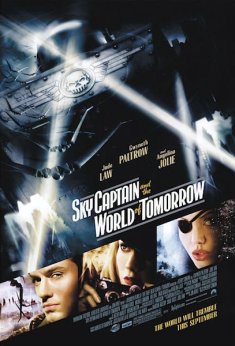
Sky Captain and the World of TomorrowIf the Indiana Jones series was a bit more sci-fi (even than Crystal Skull, that is), it might be rather like this. First time writer-director Kerry Conran evokes ’40s cinema serials more thoroughly than Lucas or Spielberg ever dared with a globe-hopping tale of a mad scientist’s giant robots doing all sorts of damage in a quest for… well, that would spoil the ending.

In the telling, Sky Captain is every inch a Boy’s Own adventure, packing every facet of that genre of storytelling into its brisk running time. There’s secret bases, ray guns, giant robots, flying aircraft carriers, snow-bound Himalayan treks, creature-infested secret jungle islands, huge underground bases, space rockets, planes that are also submarines, tree bridges over impossibly deep gorges… If it’s part of the genre, it’s probably here, and all finally executed with ’00s-level special effects. In some respects it does move between set pieces and locations in an episodic fashion, but then that’s more a trait of the films it emulates — i.e. episodic serials — than a flaw in Conran’s plotting.

Still, some might view Sky Captain as little more than an exercise in filmmaking — it was one of the first movies to be shot entirely on blue-screen, around the same time as Sin City and a couple of others. There’s more to it than that, but it’s also hard to ignore the style this creates. The shooting process is far from perfect if one were trying to recreate real life, but here the whole look is so stylised that it hardly matters. The period setting is nicely evoked, combining myriad influences into an intricately realised retro-future style, coupled with a lovely sepia sheen over everything. It’s beautifully lit, while individual shots and editing are frequently reminiscent of a style from the ’40s (and earlier). Again, Conran is being deliberately evocative of films of the period, rather than a modern film set then; more La Antena than Star Wars.

Another much-discussed feat of technology is the resurrection of Sir Laurence Olivier as the film’s villain. Unfortunately, his brief appearance is underwhelming. Perhaps we’ve become too accustomed to modern technology resurrecting deceased actors for ‘new’ performances (not that it happens that often); but then again, what was done with Oliver Reed for Gladiator — four years before this — seemed more impressive than the small amount of hologram we see here, even though the digitally created shots were equally brief. It’s a shame, because using Olivier for this key role is quite neat, certainly better than casting a glorified extra. In fairness, then, it’s a part so small that very few appropriately-big names would agree to it, which perhaps permisses resurrecting Olivier after all

Among the real performances, the acting is a bit flat. Perhaps this is deliberately in-keeping with the emulated style, though Jude Law is always this bad so maybe not. Similar comments could be made of the screenplay, if one were being unkind. What it does manage is a good amount of humour — an essential part of the genre, as any Indiana Jones fan will tell you, but it’s by no means guaranteed in these over-serious times (thankfully, the likes of Star Trek and Transformers are occasionally breaking down this barrier to fun).

Breaking free of any self-imposed period constraints, Conran also produces a few exciting action sequences, such as a plane chase through the streets of New York. It’s incredibly hard to create spectacle these days, but Sky Captain occasionally manages it. There are also lots of fun little references to other things for the keen viewer to pick out. 1138 crops up, inevitably, but my favourite is some dialogue lifted from Orson Welles’ War of the Worlds.

Sky Captain is a healthy dose of retro-styled fun. Perhaps that makes it an acquired taste, but there’s certainly nothing wrong with that.

4 out of 5

My review of the proof-of-concept short that inspired Sky Captain can be read here.