Sherlock (2002)

aka Case of Evil / Sherlock: Case of Evil

2009 #46
Graham Theakston | 89 mins | TV | R

Case of EvilSherlock Holmes is a character so well known in the international psyche that he is open to seemingly endless reinterpretation — a wartime spy in the Rathbone era, his younger self in a Temple of Doom remake, or cryogenically frozen to reawaken in the 22nd Century (no, really). Indeed, this year alone we can expect to see him re-imagined as both a wisecracking martial artist in a period-set action/adventure film from Guy Ritchie, and as a detective in the present day in a new TV series from Steven Moffat and Mark Gatiss. All of which are considerably more exciting than this lame Young Sherlock effort from 2002.

Here, writer Piers Ashworth — who would go on to pen the new St Trinian’s and Goal! III (for which be sure to read the review at The Big Whatsit) — creates a kind of Holmes Begins, showing a young and unknown Sherlock break his first case against renowned criminal Professor Moriarty, gaining a bit of fame before he joins the investigation of a serial killer. Ashworth makes sure to complete the Begins format with introductions for various iconic elements, like the deerstalker (though only in the final scene), the pipe (though, only in the final scene), and even his drug addiction (though Holmes seems to have already been cured of it).

More fundamentally, however, Holmes is recast as a kind of Victorian James Bond, both in terms of his character and the plot structure. It begins with the end of the previous mission (which, GoldenEye-style, will become relevant later), before progressing through various familiar beats, like the villain helpfully explaining his plan and a climactic big shoot-out a la You Only Live Twice or The Spy Who Loved Me, except on a much, much, much smaller scale. To add to the effect, Dr Watson is revealed to be “a bit of an inventor” — a Q in the making? Even Holmes himself is not immune: young, dashing, and womanising. Yes, womanising. He even has a threesome, shot and scored like soft porn, though with a US TV-friendly complete lack of nudity. Or sex. It does feature an unintentionally hilarious striptease though.

The story itself moves at a decent lick early on, complete with some genuine detective work that even, occasionally, displays Holmes’ genius. Most of this (at least, most of it that’s actually relevant to the plot) occurs during a couple of autopsies, which choose not to stint on the gore. (Incidentally, this makes it even easier to believe it was created with US TV in mind. Nudity? Nooo. Gore and violence? Hurrah!) Unfortunately, the longer the film goes on the more it slows and begins to drag, and the mystery-solving is replaced with running around, backstory exposition, and semi-decent sword fights. The best of these is fortunately at the climax, which takes place (amusingly, like Basil the Great Mouse Detective) atop the Palace of Westminster clock tower — or, at least, a poor computer-generated version of it (also like Basil the Great Mouse Detective). To be fair, the interior is a decent-enough set… though quite how the clock faces function when no workings whatsoever are attached to them is a mystery worthy of Holmes. Sherlock was shot in Romania, so such dodgy effects work rears its head any time they wish to depict a London landmark. Thankfully this isn’t often, because every such shot is appallingly realised.

Much the same could be said of the performances. James D’Arcy initially seems miscast as Holmes, but… well, he is — it’s just that everyone else is even worse. Roger Morlidge’s Dr Watson feels like he’s being portrayed by Ricky Gervais — no, worse, like James Corden’s version of Gervais from Horne & Corden — while Vincent D’Onofrio’s accent wavers all over the place and takes his performance with it. In what amounts to a cameo as Mycroft Holmes, Richard E. Grant is dreadful too. I’ve never been much of a fan of his, but this is weak work even by his standards. About the only passable performance among the major characters comes from Nicholas Gecks as Lestrade. There’s nothing exemplary about his role, but by simply doing nothing wrong he fares better than the rest.

Sherlock probably sounds irredeemably awful, and for some it will be (Sherlock Holmes has a threesome for Chrissake!), but despite the numerous flaws it remains largely watchable and even has its moments, particularly for more forgiving non-Sherlockians.

2 out of 5

Sherlock featured on my list of The Five Worst Films I Saw in 2009, which can be read in full here.

The Knack …and How to Get It (1965)

2009 #34
Richard Lester | 85 mins | download | 15

The Knack …and How to Get ItI’ve never actually seen a Richard Lester film before, and so spectacularly failed to put two-and-two together about who the director was and what else he’d done before I watched this. If I had, recent (at the time of viewing) reviews of the BFI’s release of Lester’s later The Bed Sitting Room (such as John Hodson’s or Clydefro Jones’) might’ve prepared me for what was to come.

As it was, all I had to go on was the DVD art (as used by iTunes — this was another 99p Film of the Week), the bright and breezy title, and that it stars Frank Spencer. From that you’d be forgiven (I hope) for thinking The Knack was a colourful Swinging Sixties sex-com romp. Upon watching it, however, it’s immediately clear it’s nothing of the sort: it begins with a dream/nightmare sequence, complete with horror-esque music, before settling into a style and rhythm more reminiscent of Breathless than Confessions of a Window Cleaner.

At least, it does for a bit. In fact, it does a lot of things for a bit: Carry On-level double entendres, intense thriller-like scenes, slapstick sequences, an occasional New Wave-esque light jazz score… If it were an American schoolchild The Knack would surely be diagnosed with ADD, flitting around from one style to another with no immediately obvious rhyme nor reason, except perhaps a desire to try out interesting things and see where they lead. This will undoubtedly put some people off — on another day, I might be included among them — but instead I found it quite intriguing.

Stuck in the middle of what could have been a slew of directorial flourishes, the cast are allowed to surprise with some layered performances. Michael Crawford more or less does an early version of Frank Spencer (in fairness, that’s perfect for the role), leaving him overshadowed by Ray Brooks as lothario Tolen and Donal Donnelly as the slightly kooky Tom. Both subvert their initial impressions: Donnelly’s oddness hides a perceptive intelligence, while Brooks’ suave lover hides a subtly unnerving, menacing, dominating sexual predator. Some of the time, anyway.

There’s no doubt that I’m severely under-qualified to pass any kind of serious judgement on The Knack (some would say any film, but there you go). I’ve not even mentioned Rita Tushingham (apparently something of a ’60s icon), or Ray McBride (who or what is he, and what is his relevance?), or that it won the Palme d’Or at Cannes in 1965 (I do know what that is at least). A proper, informed judgement is therefore best left to those with a greater familiarity with Lester’s films (or at least his early work, before he went on to the likes of The Four Musketeers and Superman III). But to those equally as uninitiated as I, The Knack can be recommended as an unusual but surprising piece of work, full of things to pique one’s interest.

4 out of 5

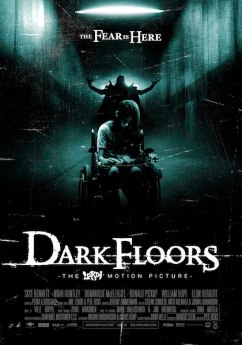
Dark Floors (2008)

2009 #26
Pete Riski | 82 mins | DVD | 15 / R

Dark FloorsYou may remember Lordi, the surprise winners of the 2006 Eurovision Song Contest. If that doesn’t help, they were the Finnish rockers all dressed up in monster suits. Here in the UK we gave them our highest number of points.
You’d be easily forgiven if you had forgotten them, but clearly someone hasn’t as they not only made this film, someone thought they were big enough to use in its promotion — it’s subtitled “The Lordi Movie” on posters, DVD covers and what have you. Maybe they’re still well-known in Europe. Or Finland. Yet despite the country of origin, Dark Floors is in English, with a predominantly British cast, and it appears to be set in America. On top of which, it has a surprising level of glossiness (albeit glossy gloominess) that, if you didn’t know better, would suggest a moderately budgeted US horror flick. Apart from the monster costumes.

In fact, expectations are gratifyingly knocked down at every turn. Riski’s direction and the cinematography are very slick, though some of the action/horror sequences lack much tension — the film effectively builds tension for these sequences, but rarely, if ever, delivers genuine scares on the back of it. While this isn’t always a bad thing, one begins to learn the tension being built isn’t likely to lead anywhere, robbing it of much impact. Effects, music and sound design also lend the project a higher budget feel than initial impressions suggest. As mentioned, Lordi’s costumes are the weakest bit, neutered either by familiarity — there’s no chance of genuine shock value if you recognise them from brightly-lit TV performances — or quite simply not having been designed for this kind of scrutiny or story. Riski does his best, hiding them with lighting, angles and special effects, but it’s not perfect.

Monsters aside, performances are pretty good. No one is outstanding but equally there’s nothing glaringly awful, always a plus for B-movie-level horror. At times the characters seem to accept the bizarre events that are occurring with too little reaction, though in fairness this is partly the fault of the script. What the latter occasionally lacks in believability (within a fantasy/horror context, obviously) it makes up for in efficiency. Admittedly this also means the whole cast are stereotypes, but it’s the world they find themselves in that’s of more interest.

Indeed, Dark Floors features more intriguing mysteries than it can keep a handle on, merrily setting them in motion but ultimately failing to pay many off. It’s packed with interesting imagery and good ideas, many of which aren’t hammered home, but equally many are never explained — key among these being… well, The Whole Thing. The final scenes seem to suggest there is some meaning, but it never comes close to a clear revelation. Having read around, it’s clear that it can be interpreted multiple ways (one of my favourites references an old Finnish children’s song), and so perhaps the makers are after a Cube vibe. Despite some surface similarities to that film’s awful first sequel, the overall effect thankfully sways closer to the original.

Some have called Dark Floors boring, but I think this is again a case of misaligned expectations — I found it never less than well-made and thought-provoking. There are undoubtedly weak spots, yet you’ll find weaker in plenty of major movies. That doesn’t excuse the flaws, but it shouldn’t be written off as a meritless B-movie because of them. One can’t help but think the project would have been better received if it hadn’t been conceived by and starred a slightly camp Finnish rock band who are never seen out of their monster costumes. It is, I feel, one of many cases where if you changed the credits to name certain other directors it might be beloved and endlessly debated by a certain sector of film fans rather than dismissed as “a glam rock band trying to be deep”.

It may even provide greater rewards on repeat viewings, especially if one wants to decipher the ending, because of its circular storytelling. Some elements of this are clear immediately (when Ben shoots up the stairwell, for example), others half-clear (it treats the audience with an above-average degree of intelligence in this respect), while other bits may only make sense (if they do, that is) with another viewing and/or some interpretation. Tobias and Sarah spend a lot of time repeating things or saying things out of context, for one — might these find a greater meaning second time through?

In a similar vein, I can’t help but wonder if in trying to be quite clever Dark Floors ultimately alienates the core horror audience who might pick it up; the people who’ll miss their straightforward scares and gratuitous gore and nudity. By so obviously billing it as “The Lordi Movie” and slapping on quite a lurid cover, the marketers have done nothing to suggest the film might actually benefit from the application of some brain power. True, this same problem can be alleged of the film itself — it’s only a horror film after all, and with somewhat ludicrous monster costumes at that — but I can’t help but wonder what might lurk within if people chose to look past these unfortunate style choices.

Naturally the counter argument goes that there’s not actually anything there, it’s just pretending there is instead of having a proper plot. I’m not certain which to believe.

Ultimately, an appreciation of Dark Floors comes down to its ending. The whole film is stylishly made — surprisingly so in fact — but there are no concrete explanations for what happened during it. If you like ambiguous endings there may be enjoyment in that very fact — and there are certainly plenty of theories floating around the ‘net for the interested to explore — but if you require your entertainment neatly wrapped up, I’m prepared to guarantee you’ll hate it. If, on another hand, you don’t care about the plot of your horror film as long as it’s scary… well, that all depends on your horror threshold, but if you’re a hardened horror fanatic I don’t imagine there are many chills to be had here.

I’m not entirely sure what to make of Dark Floors in the end, but err on the side of generosity because it’s well-made and has left me thinking — something I certainly never expected.

4 out of 5

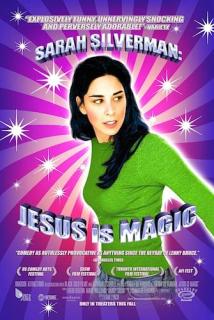
Sarah Silverman: Jesus is Magic [TV edit] (2005)

2009 #45
Liam Lynch | 50 mins | TV | 15

Sarah Silverman: Jesus is MagicStand-up concert films are an awkward business (as are rock concert films), raising questions that are oft pondered on this blog about what constitutes a “film”. After all, if this were just shown on TV or released direct to DVD rather than released in cinemas, no one would be considering it a feature. Indeed, Channel 4’s TV showing cut the 70-minute (PAL) version down to just 50, much as they do for the TV showing of any other direct-to-DVD stand-up gig. But the fact remains that this was released in cinemas (albeit not many) as a feature film. Though if it’s worthy of review under this blog’s remit, and direct-to-DVD movies are worthy of review too, surely direct-to-DVD comedy gigs should be? It’s enough to make your head hurt — something Jesus is Magic might also do, if it hasn’t sent you to sleep.

All comedy is an acquired taste, of course, but what Silverman offers here must take some acquiring. I mostly like what I’ve seen of her work in the past — I’ll admit to having I’m F***ing Matt Damon circling round in my head for weeks after first hearing it — but the lack of laughs here is enough to put me off bothering with her in future. Most of her material seems to be an excuse to say extremely rude or controversial things, and in fact often relies on these things being so rude as to provoke laughter just for that. The audience seem happy to go along, but there’s nothing inherently funny about a rude sentence — it needs a point, be it satire or surrealism (which she tries, but fails at) or something else. I have no problem with edgy or ‘offensive’ comedy, but this isn’t it.

Occasionally Silverman hits on something worthwhile amongst all the dross. Some of her comments on 9/11, the Holocaust and a handful of other edgy (and, indeed, ‘edgy’) areas raised a smile, maybe even a chuckle, proof (were it needed) that difficult topics can be covered as comedy. Even then, however, it’s only one or two gags among a raft of blabbing on those topics. At other times there are lines that desperately want to be funny, and if she’d managed to build up a head of comedic steam they’d garner a laugh as they passed, but in isolation they’re just not enough.

On a related note, the whole thing is bizarrely slow-paced. I don’t know if that’s an American thing or if British comedians are exceptional in their rapid-fire delivery — or just “relatively rapid-fire delivery”, because even the slowest joketeller you’d encounter on something like Live at the Apollo can spit them out twice as fast as Silverman — but she seems to take forever to get anywhere. Anywhere at all, that is, never mind to an actual joke. Few, if any, British comedians would survive at this pace.

Directorially, it’s a simple concert film, perhaps an over-edited one. Lynch splashes out during a couple of musical numbers, producing the occasional background gags this way — the people Silverman passes during I Love You More, for example — though at other points he’s just as guilty of spending too long on something that’s either not funny or that becomes humourless through exhaustion, such as the black people she encounters at the end of the same song.

Based on comments in online reviews, it seems Channel 4 mostly cut documentary material for their abbreviated TV showing. Whether these insights add some weight to proceedings or just slow the film down further I don’t know, but I’m thankful I didn’t have to suffer through another 20 minutes of this. As noted at the start, this editing (just like other stand-up DVDs transferring to TV) lends credence to the idea that this isn’t really a film. Whether it is or not ultimately doesn’t matter, other than if you’ve paid to see a comedy it would be nice to hear some gags — why go to the cinema for a humour-free evening you could stay at home with Michael McIntyre’s Comedy Roadshow and actually have a laugh?

1 out of 5

Also see Eamonn McCusker’s review at DVD Times for a similar perspective. I’d especially echo his final paragraph: “Or the everyday conversations that you can hear up and down the country, which [would] leave Silverman blushing. Compared to all that, Silverman seems safe.” It’s great to be British.

Sarah Silverman: Jesus is Magic featured on my list of The Five Worst Films I Saw in 2009, which can be read in full here.