2009 #9
Zack Snyder | 162 mins | cinema | 18 / R
This review contains major spoilers.
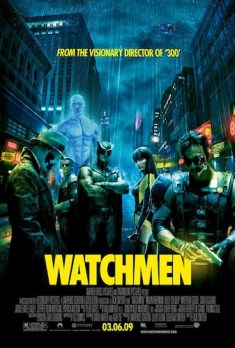 Watchmen didn’t flop. Let’s get that out of the way.
Did it do less business than expected? Yes. Were expectations unreasonably high? Unquestionably. After the barnstorming success of The Dark Knight I think some expected a repeat run, but they forgot that while TDK was dark, it still had clear heroes, clear villains, a massively popular franchise and — let’s be honest — a highly-publicised, highly-acclaimed final performance from a certain tragic young actor. Watchmen, by comparison, is densely plotted, morally ambiguous, a tad on the long side, with unknown characters, an unclear story (in the marketing at least) and no mass recognition. And it was rated R. All this considered, it did phenomenally well, and at the end of the day it’s WB’s fault for spending $150m on something that, realistically speaking, wasn’t going to make that back on opening weekend.
But this isn’t meant to be a rant about the box office. Now that the dust has settled somewhat from the initial flurry of reviews — which on the whole seemed to either hail it as an instant classic or an unrelenting mess (though some more reasonable ones found the middle ground) — and with the dubiously-featured UK DVD and Blu-ray releases just announced, it seems about time to add a few of my thoughts to the already-overflowing mix. In doing this I find it impossible to fully divorce myself from the fact that I’m a fan of the book, so can only really view this adaptation from that perspective; just as I think anyone who’s read the book can’t truly imagine quite how a non-reader will take this, whatever they may claim. The only people who can do that are people who haven’t read the book, and there have been plenty of those reviews around too.
But even as a fan, my opinions are not as predetermined as some might think. Watchmen is incredibly faithful to its source material (some notable tweaks and omissions aside), but while some have loved it for this, others have viewed it as weak or pointless. Perhaps some of the complaints about faithfulness stem from the fact that we’re actually unused to seeing faithful superhero adaptations — “adaptations” being the operative word. Across seven Batmans, five Supermans, four X-Mens, three Spider-Mans, two Hulks, and countless others, how many actually adapt a specific book? Most, if not all, develop their own story around the notion of the character(s), or take some degree of inspiration from various storylines, tailoring a new tale for the different medium (well, theoretically). In choosing to adapt the source rather than make a film starring the same characters, Watchmen places itself more in line with other literary adaptations than other superhero movies. Some would argue this context still renders it more of a Da Vinci Code than a Godfather, but it’s perhaps still appropriate to debate that rather than if it’s more a Hulk than a Dark Knight.
The consistent faithfulness is a bit of a mixed bag. For much of the film it’s a great story well re-told, and its climax actually manages to improve on the original’s to the extent that, if Alan Moore ever actually watched it (which he won’t), I’d like to think he’d be man enough to admit that this one change at least was an improvement. Similarly, in the novel I wasn’t convinced Rorschach’s final moments made sense — it seemed out of character. On screen, however, Jackie Earle Haley completely sells it, his final scream becoming one of the film’s most memorable moments. Other elements are retained with no thought, however: the intercutting of Dan and Laurie’s alley fight with Dr Manhattan’s press conference is an effective (if blunt) sequence in the novel, but on screen makes little sense — even though I know the story and know the events of both scenes, this choice left me struggling to follow events. Even worse, the sudden and unexplained presence of Ozymandias’ pet big cat is almost baffling to a viewer familiar with the source, and so I can only imagine how little sense Bubastis must make to a new viewer. Consequently, his demise has no emotional weight.
The final scene is a bit of a misstep as well. In the book it’s a perfect little coda, beautifully ambiguous and tied to several of the novel’s themes. On screen, Snyder overplays it, allowing it to drag on with pointless dialogue and leaving the point of the scene feeling forced — equally a fault of David Hayter and Alex Tse’s script, then. Part of the problem is that it’s lumbered with introducing a subplot and its characters for the sake of the payoff, both of which develop slowly and appropriately in the novel. The details of that particular subplot are not the only elements that are missed from the original: the novel contains a lot of details of street life in Manhattan, for example, which makes the city’s ultimate destruction more personal for the reader. Some of these scenes have been filmed and, knowing that an aptly-titled (for once) Director’s Cut is on the way, it’s at times hard not to view the theatrically-released Watchmen as an abridged version. While it is still more complex than some critics (both pro and fan) give it credit for, the missing nuances and subplots would strengthen the whole experience. We can but hope it’s these that the Director’s Cut will include, rather than just a collection of completist-pleasing trims.
It’s easy to complain about Watchmen — clearly — but, actually, I really enjoyed it. Snyder has arguably created a live-action version of the graphic novel rather than creating a film in its own right, but is that really a bad thing? It’s what many literary adaptations aspire to, the only difference here is there were already some pictures to directly transfer. Some will disagree, and if you do then this is a perfect argument for why Non-Fans should be in charge of film adaptions — Fans are too concerned with pleasing other Fans, in this case being rigorously faithful; Non-Fans often just want to make the best movie possible based on the source material, rather than making the best translation (or, perhaps, re-appropriation). Perhaps it’s too fine a line to walk; perhaps Snyder was too afraid to change anything; or perhaps it’s just a case of damned if you do (“it’s exactly the same, what’s the point?”) and damned if you don’t (“he changed too much, it’s not Watchmen!”).
In their faithfulness, Snyder, Hayter and Tse retain much of the story and character elements that made the original great. If the aim was to take the page and put it on screen, the screenplay is near flawless, embellishing some moments and even fixing others, while excising subplots so wisely I didn’t miss much. As stated, however, the definitive cut is surely the forthcoming one. As for Snyder’s direction, he mostly does a good job, recreating iconic panels — occasionally with too much reverence, true — but enlivening other sequences in his own way. In fact, for all the moans of reverence, some of the novel’s more filmic ‘cuts’ are actually abandoned (I’m thinking specifically of the ins & outs of flashbacks during the Comedian’s funeral). Photography wise, most of the film was far too dark, and I couldn’t help but wonder if it had been shot too much with DVD/Blu-ray in mind and suffered when projected. I suppose we’ll see later…
Snyder certainly left a clear directorial stamp on one element of the film: occasionally the action sequences smash into slowmo, sometimes to the point of freeze frame… exactly like they did for most of 300’s fights. Whereas there it looked kinda cool and felt like a stylistic tick unique to that film, here one can’t help but think time is being wasted that would be better spent on expanding the dense plot. And rather than being a stylstic quirk of 300, it now becomes one of Snyder’s; which means that, from the very first scene, “A Zack Snyder Film” is stamped all over this like a young boy with an abundance of name stickers. There’s nothing wrong with making it his own film, of course — I’m sure Gilliam’s or Greengrass’ versions would’ve slotted comfortably into their distinctive oeuvres — but it would be nice if it weren’t quite so intrusive. On the other hand, could it be that the expectation of this makes it seem worse than it is, and if any other director had pulled the same tricks it wouldn’t seem as apparent?
Similarly, the violence is incredibly brutal, gory and graphic — but that’s the point. Though they live in a heavily stylised world, these are ‘real’ superheroes, and real violence isn’t pretty. The level of brutality is appropriate to the theme but never lingered on more than is reasonable and rarely over-done. Those who aligned it with ‘torture porn’ flicks like Hostel in their criticism of the film were missing the point.
The film’s soundtrack has also come in for criticism in some quarters, where certain tracks have been accused of being entirely out of place and others have been suggested as replacements. However, the tracks lambasted and others put forth suggest that these particular critics (usually amongst fandom) have a rather narrow taste in music, with the suggestions often too obscure to suit. In fact, Watchmen’s soundtrack provides a nice variety of contemporary songs, spanning styles in order to quickly define an era rather than to evoke what a specific genre was doing at the time — so a 1970s riot is accompanied by disco, for example, rather than a niche rock track. It makes absolute sense from a filmmaking standpoint and, for those of us with broader tastes, is perfectly pleasant. Elsewhere, the choice of music references both the original text — Rorschach and Nite Owl’s arrival in Antarctica is set to Jimi Hendrix’s All Along the Watchtower (while the novel quotes Bob Dylan, here its use as an action cue means Hendrix fits better) — and other films — the Vietnam sequence is knowingly set to Ride of the Valkyries. There are some missteps — the use of Leonard Cohen’s Hallelujah over the sex scene is presumably meant to create a moment of euphoric triumph, but is instead laughably cheesy — but, most of the time, it’s a success.
The other major addition from the graphic novel is, of course, a cast. As already noted, Jackie Earle Haley is incredible in the default-lead role of Rorschach. He may’ve nicked Christian Bale’s Batman voice, but it’s much more suited here. Patrick Wilson’s Dan Dreiberg/Nite Owl II is also great, showing the benefit of hiring proper actors rather than stars. Jeffrey Dean Morgan and Matthew Goode hold their own in potentially challenging roles. Some didn’t — and don’t — think Goode was right for Adrian Veidt, but I preferred his portrayal so much that the more butch-looking Ozymandias of the novel now seems wrong to me. The female leads suffer more. Malin Akerman is about passable, but Carla Gugino is quite possibly miscast. It’s a tricky part to get right, having to be both young and sexy in the flashbacks but an old woman in the story’s present day, and so it may be more the fault of some poor old-age makeup than Gugino’s.
That’s not to mention Billy Crudup, who has the double challenge of playing a man who has become God-like, and of giving this performance underneath a big pile of CGI. And with a CG penis on show too. Personally I didn’t find the CG manhood as distracting as many others seem to have, and Crudup’s actual performance is captivating — there’s a thin line between aloof otherworldliness and reading dialogue aloud in a monotone, but Crudup managed to fall on the right side of it.
Surprisingly, I’ve made it through almost 2,000 words without mentioning the title sequence. There’s no need to describe it any more, it is simply brilliant. More dioramas were shot than made it into the final cut, so I can’t help but hope they’ll be reinstated in later versions.
In summary (if this ramble around Watchmen can be summarised), Zack Snyder’s Watchmen Film is not “the big screen equivalent of Alan Moore’s Watchmen” — that would be a movie, likely very different to the graphic novel, that examined and deconstructed representations of superheroes in cinema and television. Instead, Zack Snyder’s Watchmen Film is “Alan Moore’s Watchmen on the big screen”, a blisteringly faithful adaptation of the source. Crucially, however, it is not (always) blindly faithful — the ending being a case in point — but some will still ponder its relevance. Judged as an artistic work in its own right, then, it perhaps comes up lacking. Judged in comparison to other faithful adaptations of great literature, however, it’s arguably as good as many others. At the very least, it’s exposed a wider audience to the characters, themes and debates of the original, and, whether they like it or not, that can only be a good thing.
In closing, I’m reminded of a comment made by Danny Boyle when discussing his favourite film ever made: “it’s imperfect; which every film should be.”
My review of Snyder’s preferred Director’s Cut can now be read here.
That version placed 3rd on my list of The Ten Best Films I Saw For the First Time in 2009, which can be read in full here.

 The Wraith of Cobble Hill is a perfect example for this debate as its modern, urban story seems to clash with the cartoonish style employed to bring it to the screen. There are no flights of fantasy, few implausible shots, nothing that couldn’t be achieved in live action even on a low budget. Ultimately the only reason for it being animated is, why shouldn’t it be? Personally, I’m not convinced it works; at the very least, it distracted me enough to consider it.

 Between becoming a Geek God with
 In Bruges has gathered quite a bit of indie-level praise and acclaim, culminating in wider recognition at the Oscars and other awards ceremonies at the start of this year. For those like me, finally getting round to seeing it in the wake of all this, it comes with quite a burden of expectation on its shoulders. Can it possibly be the modern classic many make it out to be? I mean, it is set in, y’know, Bruges…
 100Films.co.uk